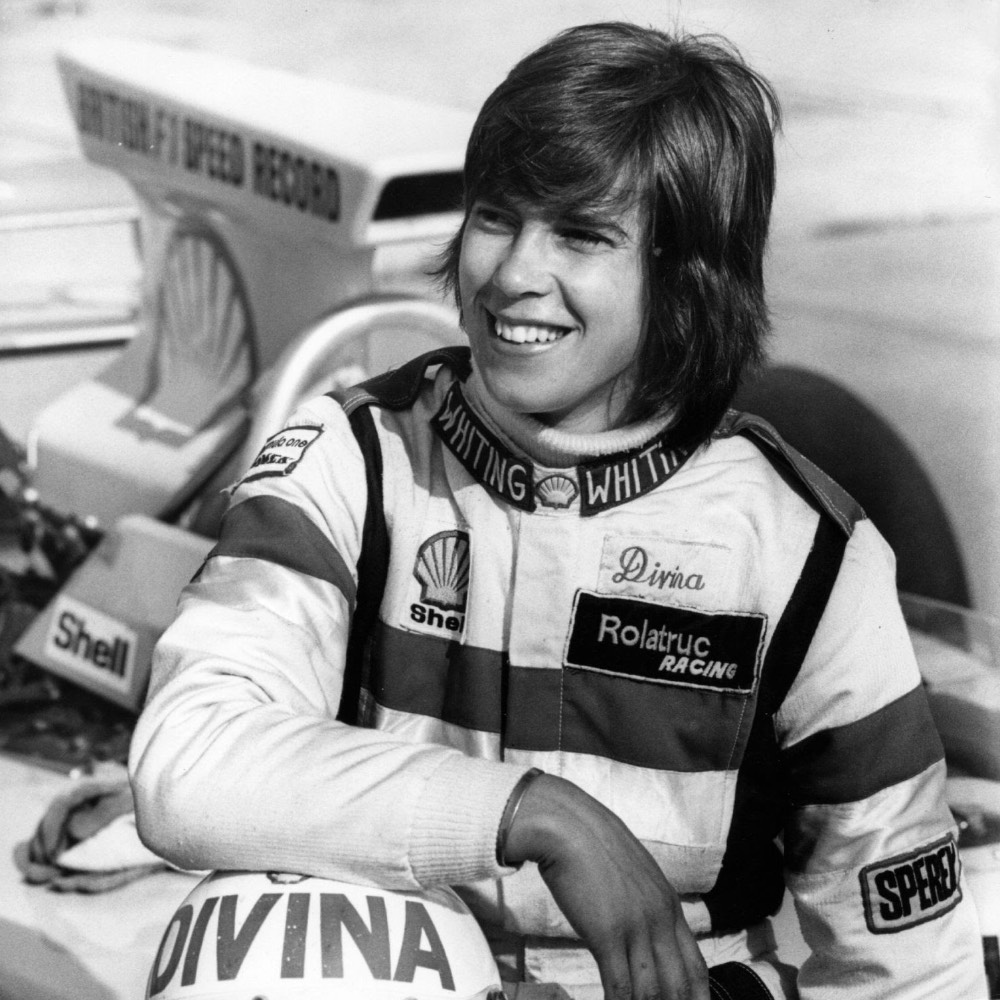
Divina Galica
Career Statistics
Biography
Divina Mary Galica MBE (born 13 August 1944) is a British former racing driver and Olympic skier who attempted to qualify for three Formula One World Championship Grands Prix during 1976, 1977, and 1978, failing to qualify for all three attempts while driving various Surtees and Hesketh chassis, though her motorsport career represented far more than these unsuccessful Formula One qualifying sessions, as she had previously competed in four Winter Olympics as a member of the British ski team, set the women's downhill skiing speed record at 125 mph, won multiple British Shellsport Group 8 races, and set the Formula One car lap record at Donington Park, making her one of only seven Formula One drivers to have competed in the Olympic Games and one of only five women to attempt Formula One qualification during the sport's first 75 years.
Born in Bushey Heath, Hertfordshire, England, Galica was introduced to skiing at age four when her mother June took the eldest four of her six children on holiday to Lenk, Switzerland, and she quickly demonstrated natural athletic ability that would carry her to the international level in Alpine skiing. Galica competed in four Winter Olympics—1968, 1972, 1976, and 1980—representing Great Britain in Alpine skiing events, and she captained the British Women's Olympic Ski Team in both 1968 and 1972, achieving the honor of leading her country's team at two consecutive Olympics, and she notched up two World Cup podium finishes during her skiing career, establishing herself as one of Britain's most successful winter sports athletes.
Her transition from skiing to motorsport began almost accidentally when she was asked to participate in a celebrity race and discovered natural talent for driving racing cars, and remarkably, just one year after first trying motorsport, Galica was participating in the 1976 British Grand Prix weekend, attempting to qualify for Formula One's most prestigious race. In 1976, Galica was taken under the guidance of motorsport promoter John Webb and team owner Nick Whiting, who entered her in the British Shellsport International Group 8 series driving a Surtees TS16 Formula One car, giving her valuable experience with Grand Prix machinery while competing in a national championship that allowed her to develop her skills without the intense pressure of World Championship competition.
At the 1976 British Grand Prix, Galica had the distinction of reintroducing the number 13 to Formula One—a number that had been avoided for years due to superstition—though she failed to qualify for the race, unable to match the pace of the established Formula One drivers and teams competing that weekend. For 1977, Whiting acquired a second-hand Surtees TS19 for Galica to campaign in the British Shellsport series, and the TS19 proved to be a wonderful car that allowed her to demonstrate her abilities, as she achieved four podium finishes—at Snetterton, Mallory Park, Donington, and Brands Hatch—and set fastest lap at both Donington and Brands Hatch, with her Donington lap record for Formula One cars standing as the circuit record for years, proving that she possessed genuine speed when racing against appropriate competition.
In 1978, Hesketh Racing offered Galica the opportunity to replace Rupert Keegan in the team's Hesketh 308E, and she brought Olympus sponsorship with her, but she failed to qualify the uncompetitive 308E for either of the 1978 season's first two races before her Formula One opportunities ended. After her Formula One qualifying attempts proved unsuccessful, Galica switched her attention to the Thundersports S2000 sports car class where she achieved numerous top-ten finishes, and she also competed in truck racing, demonstrating the versatility that had characterized her transition from Olympic skiing to motorsport. Following her active racing career, Galica became a racing instructor with the prestigious Skip Barber Racing School in the United States, and her talent and professionalism led to her rising through the organization to become Senior Vice President of Skip Barber Racing, managing both the school's driving instruction programs and its racing series, making her one of the most senior women in American motorsport during the 1990s and early 2000s.
In 2005, Galica left Skip Barber to work for iRacing.com as a director in the company, transitioning into the emerging world of online racing simulation and helping to develop one of the most sophisticated racing simulators available, and since 2018 she has worked for Bertil Roos Racing School as a driving instructor, continuing to share her extensive motorsport knowledge with new generations of racing students. Galica was made a Member of the Order of the British Empire (MBE) for her sporting exploits across both skiing and motorsport, recognizing her achievements as one of Britain's most versatile and accomplished female athletes, and her status as an Olympic athlete who also attempted Formula One qualification places her in extraordinarily exclusive company.
Divina Galica's Formula One statistics—three qualification attempts, zero race starts, zero points—tell only a tiny part of her remarkable story, as her four Olympic appearances, her World Cup skiing podiums, her women's downhill speed record, her British Shellsport championship podiums, her Donington lap record, and her subsequent career as a senior racing school executive demonstrate achievements that transcend her failed Formula One qualifying attempts and establish her as one of British motorsport's pioneering women who competed at the highest levels in multiple sports during an era when female athletes faced far greater obstacles than exist today. Her story serves as inspiration for female athletes across all sports, demonstrating that talent, determination, and versatility can overcome societal barriers and that success should be measured not merely by Formula One qualification but by the breadth of achievement across multiple disciplines and the lasting influence on future generations of competitors.