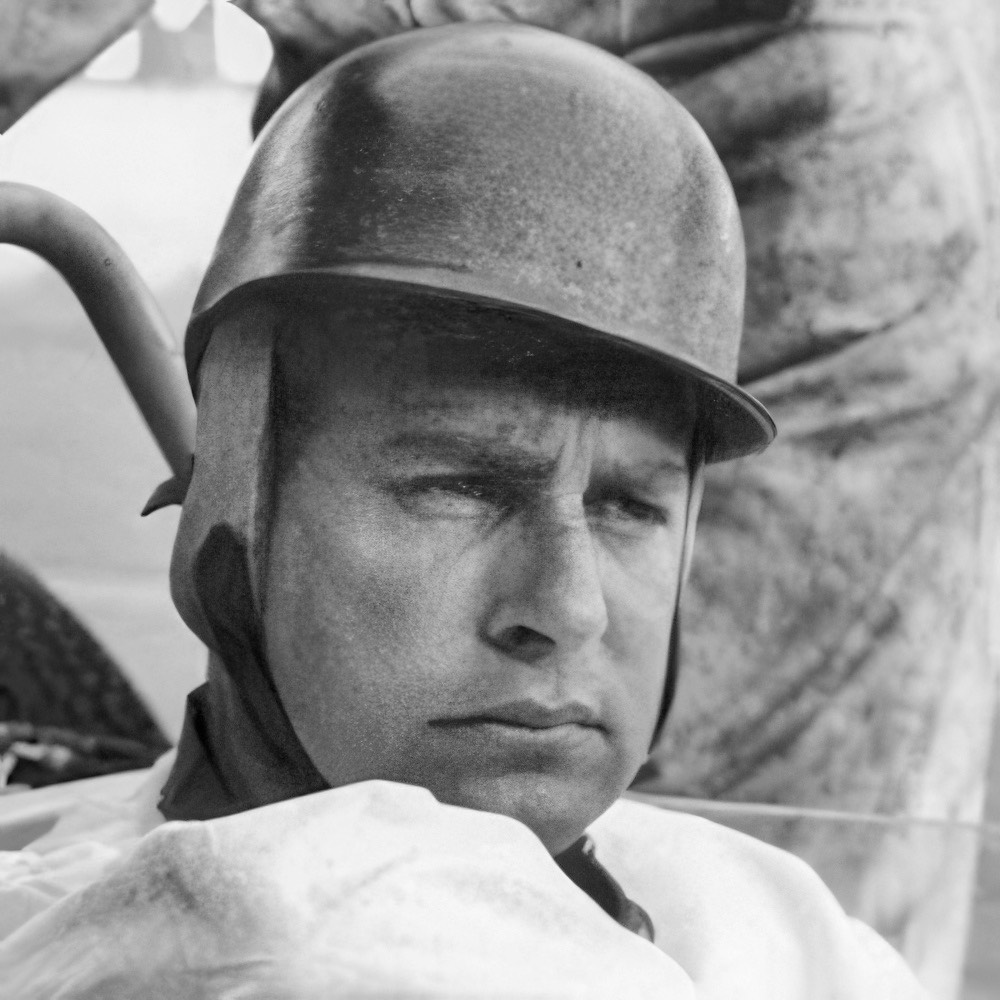
Ian Burgess
Career Statistics
Biography
Ian John Burgess (6 July 1930 - 19 May 2012) was a British racing driver who competed in 20 Formula One World Championship Grands Prix from 1958 to 1963, never scoring championship points, before mysteriously disappearing from public life until his 1981 arrest for drug smuggling—a bizarre conclusion to a racing career that had shown genuine promise. Born David William Allan in London on 6 July 1930, Burgess was adopted as a baby and went to live in Bletchingley, near Reigate, with a Scottish couple named Burgess, taking their surname. Burgess began his racing career in 1950 with a Cooper Formula 3 car, competing in Britain's thriving 500cc Formula 3 category. His 1951 season proved particularly successful, highlighted by an outstanding victory at the Eifelrennen at the Nürburgring.
Racing in torrential rain, Burgess defeated 25 other drivers to win outright on the demanding German circuit, immediately establishing himself as a driver with exceptional wet-weather car control and natural talent. Following his Formula 3 success, Burgess moved to sports cars and Formula 2, though he achieved less success in these categories than his Formula 3 performances had suggested. By the mid-1950s, Burgess had begun working for Cooper, both in their factory and at their drivers' school based at Brands Hatch, combining employment with racing opportunities. He raced one of Cooper's works Formula 2 cars in 1957, achieving fourth place at the prestigious Oulton Park Gold Cup, demonstrating competitiveness against Britain's leading F2 drivers.
This Gold Cup result earned Burgess a full season with Tommy Atkins' similar Cooper for 1958. The year began brilliantly with victories at Crystal Palace and Snetterton, plus fourth places at both Montlhéry in France and Reims, establishing Burgess among Formula 2's front-runners. However, disaster struck at the ultra-fast AVUS circuit in Germany when Burgess crashed heavily, breaking his leg and curtailing his season just as he was establishing championship form. Burgess made his Formula One debut on 19 July 1958 at the British Grand Prix at Silverstone.
After 40 laps—just over half the race distance—clutch issues forced his retirement, an inauspicious World Championship debut that set the pattern for much of his Formula One career. From 1959-1960, Burgess drove for Scuderia Centro Sud, an Italian privateer team fielding older Maserati and Cooper machinery. During these two seasons, he competed in eight Grands Prix, achieving his best Formula One finish with sixth place at AVUS for the 1959 German Grand Prix—then the fastest Formula One race on record due to AVUS's long straights and banked corners. This sixth-place result represented Burgess's Formula One career highlight, though it came at a non-typical circuit that didn't reflect his ability on conventional racing circuits.
For 1961, Burgess joined the American Camoradi International team, participating in just three races before switching to Anglo-American Equipe for 1962, again with only three race entries. His final Formula One season came in 1963 with Scirocco-Powell, where he competed in two Grands Prix but retired from both due to mechanical troubles. Over 20 World Championship starts from 1958-1963, Burgess never scored a championship point, with his sole points-equivalent finish being that sixth place at AVUS. Following the 1963 season, Ian Burgess vanished from public life entirely.
For 18 years, virtually no information about Burgess appeared in the public realm, leaving the motorsport community puzzled about what had happened to the former Formula One driver. The mystery ended dramatically in 1981 when Burgess was arrested by British customs after attempting to enter the UK with nearly $2,000,000 worth of heroin hidden in his car—an enormous quantity that suggested involvement in major international drug trafficking. At trial, Burgess maintained an extraordinary defense: he claimed the heroin was given to him by MI5, Britain's domestic intelligence agency, as payment for intelligence work he had allegedly conducted in the Middle East during his missing years. Burgess asserted he had been working as a spy, and the drugs represented compensation for his services rather than criminal smuggling.
The court rejected this defense, and Burgess was convicted and imprisoned for drug smuggling. Whether his MI5 claim contained any truth or represented pure fabrication remains unclear—intelligence agencies neither confirm nor deny such allegations, and Burgess's story was never independently verified. After serving his sentence, Burgess maintained a low profile until his death on 19 May 2012 at age 81. Ian Burgess's story represents one of Formula One's strangest and most mysterious careers—a driver who showed genuine talent with his 1951 Nürburgring victory and 1958 Formula 2 wins, competed in 20 World Championship Grands Prix without scoring points, then vanished for 18 years before reemerging as a convicted drug smuggler claiming to have been a spy.
The bizarre trajectory from racing driver to alleged intelligence operative to imprisoned criminal makes Burgess one of motorsport's most unusual figures, his talent overshadowed by the mysterious and criminal activities that defined his later life.