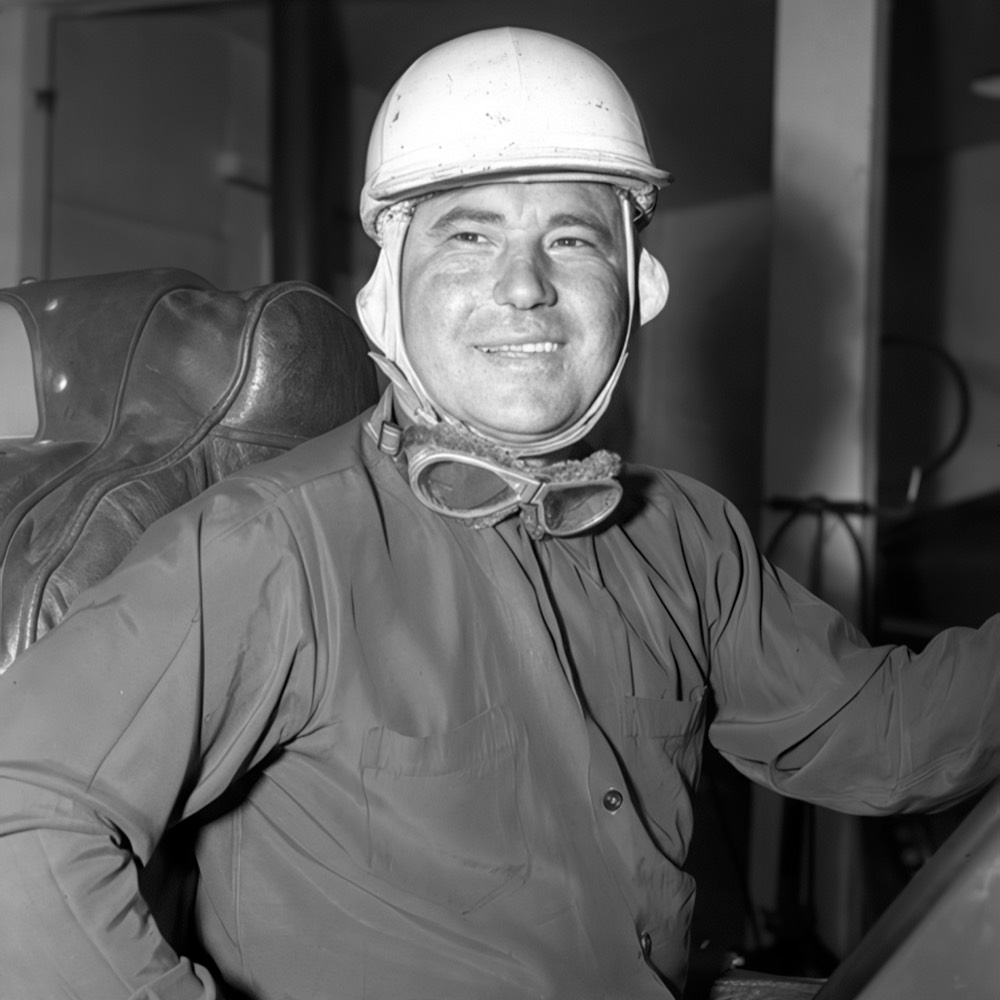
Joie Chitwood
Career Statistics
Biography
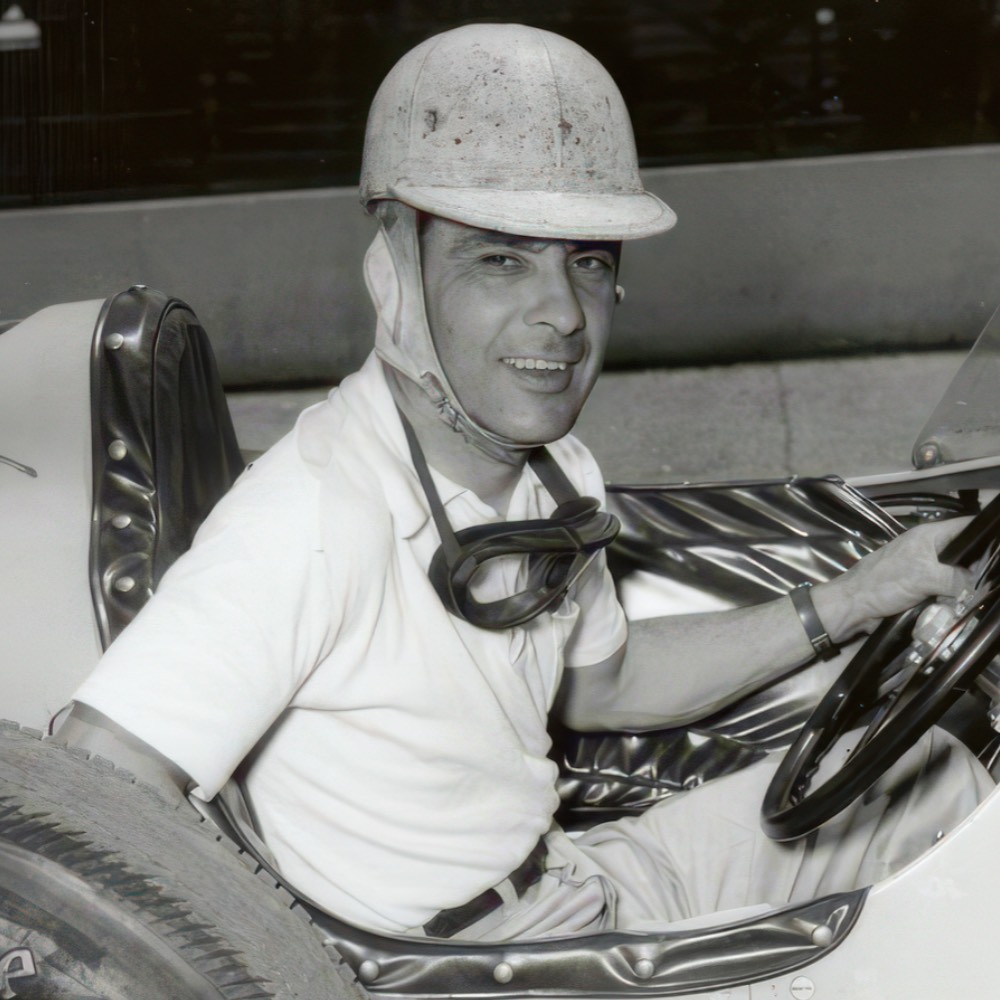
George Rice Chitwood (14 April 1912 - 3 January 1988), universally known by his nickname 'Joie' Chitwood, was an American racing driver who competed in seven Indianapolis 500 races between 1940 and 1950—with his final appearance counting as a Formula One World Championship race since the Indianapolis 500 was part of the World Championship from 1950-1960—before retiring from racing to focus on his extraordinarily successful career as an automotive stunt show promoter, becoming one of the most famous automotive entertainers in American history and inspiring generations of daredevils including the legendary Evel Knievel. Born in Denison, Texas, Chitwood acquired his nickname 'Joie' through a humorous misunderstanding when a newspaper reporter covering one of his early races misheard the name of the town St.
Joe, Missouri, where Chitwood was racing, and mistakenly reported the driver's name as 'Joie' instead of George in the race report, and the nickname stuck for the rest of his life, becoming his universally recognized identity. Chitwood began his racecar driving career in 1934 at a dirt track in Winfield, Kansas, quickly demonstrating natural talent and fearlessness that would characterize both his racing and later his stunt driving career, and he progressed rapidly through the ranks of American oval track racing during the late 1930s, establishing himself as one of the country's premier sprint car and midget car drivers. Between 1940 and 1950, Chitwood qualified for and competed in seven Indianapolis 500 races, making him one of the regular competitors at America's most prestigious motorsport event during the 1940s, and he achieved remarkable consistency at the Brickyard, finishing fifth on three separate occasions—in 1941, 1946, and 1950—demonstrating that he possessed the speed, endurance, and consistency required to compete successfully at Indianapolis.
At the 1941 Indianapolis 500, Chitwood became the first driver in history to wear a safety belt during competition, a revolutionary safety innovation that was initially met with skepticism by many competitors who feared being trapped in a burning car, but Chitwood's pioneering use of the safety belt helped normalize the practice and ultimately saved countless lives over the following decades as safety belts became mandatory equipment. The 1950 Indianapolis 500 marked Chitwood's final appearance at the Brickyard and his only race that counted toward the Formula One World Championship, as he shared driving duties with Tony Bettenhausen, and the pair finished fifth, earning one World Championship point and making Chitwood technically a Formula One driver and point-scorer, though he competed only in the Indianapolis 500 and never drove a Grand Prix car on a road circuit.
Beyond Indianapolis, Chitwood was a tremendously successful sprint car driver, winning six major sprint car races in 1946 and nine AAA East Coast sprint car features in 1947, cementing his reputation as one of America's most versatile and successful oval track competitors across multiple disciplines. However, Chitwood's greatest fame and most enduring legacy came not from his racing career but from his creation and promotion of 'The Joie Chitwood Thrill Show,' one of the most successful automotive entertainment ventures in American history, which toured North America for more than forty years and influenced popular culture in ways that traditional racing never could. The origins of the Thrill Show date to 1942, when stuntman Lucky Teter died, and Teter's widow asked Chitwood to sell the equipment from Lucky Teter's Hell Drivers show, but Chitwood was unable to find a buyer during World War II when entertainment ventures were struggling, so he made the fateful decision to take over the show himself and rebrand it as the Joie Chitwood Thrill Show.
The show was an exhibition of automotive stunt driving that included cars driving on two wheels, precision driving through narrow gaps, ramp jumps, and various other death-defying stunts, all performed by skilled drivers to the amazement and delight of spectators at fairgrounds, stadiums, and speedways across the United States and Canada. The Joie Chitwood Thrill Show became so successful that Chitwood eventually operated five separate units that toured simultaneously across North America for more than four decades, performing thousands of shows and entertaining millions of spectators, making Chitwood one of the most financially successful figures in automotive entertainment history. The show's popularity was so great that it became a cultural phenomenon, and legendary daredevil Evel Knievel later credited the Joie Chitwood Thrill Show as his direct inspiration to become a motorcycle stuntman, acknowledging that watching Chitwood's drivers perform automotive stunts had sparked his imagination and shown him that automotive daredevilry could be a viable career.
As his Thrill Show business grew, Chitwood significantly reduced his racing activities, understanding that the financial rewards and creative satisfaction of stunt show promotion exceeded those of competitive racing, and after his retirement from active racing in 1950, he devoted himself full-time to building his entertainment empire. Chitwood's contributions to motorsport safety, automotive entertainment, and American popular culture were recognized with numerous honors, including induction into the National Sprint Car Hall of Fame in 1993 and the Motorsports Hall of Fame of America in 2010, cementing his legacy as one of the most important figures in American automotive history. His family continued his legacy in motorsport, with his grandson Joie Chitwood III eventually serving in executive roles at major racing venues including Daytona International Speedway and Indianapolis Motor Speedway, carrying the Chitwood name forward into the modern era of professional motorsport management.
Joie Chitwood died on 3 January 1988 in Tampa Bay, Florida, at age 75, passing away more than three decades after his retirement from competitive racing but having built a legacy that extended far beyond his accomplishments on the track to encompass automotive entertainment, stunt driving, and American popular culture. His story is unique in motorsport history—a successful Indianapolis 500 competitor and Formula One World Championship point-scorer who achieved far greater fame and influence through entertainment than through racing—and his pioneering use of safety belts at Indianapolis in 1941, combined with his creation of the Thrill Show that entertained millions and inspired future generations of daredevils, makes Joie Chitwood one of the most fascinating and multifaceted figures in the history of American motorsport, a man who understood that automotive performance could thrill audiences whether in competition or entertainment, and who built an empire based on that fundamental insight.