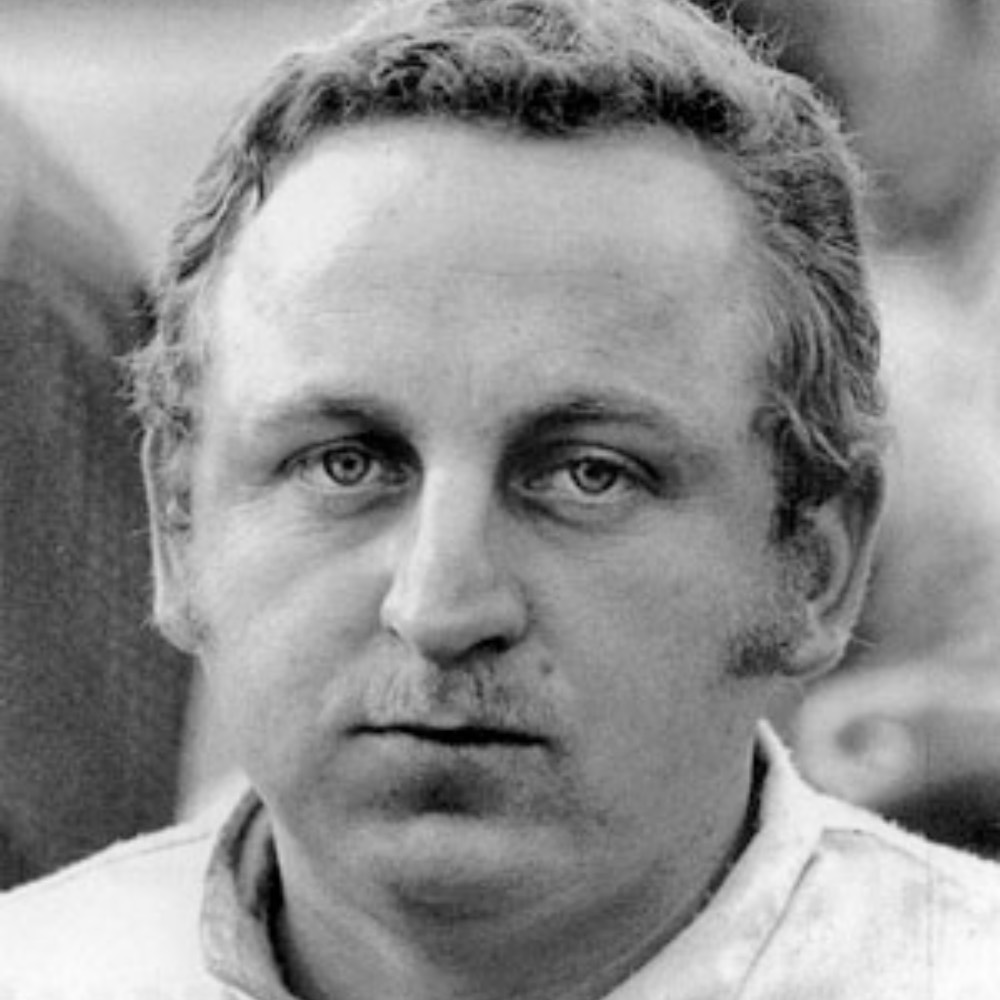
Lance Macklin
Career Statistics
Biography
Lancelot Edward 'Lance' Macklin (2 September 1919 - 29 August 2002): British racing driver from Weybridge, Surrey who participated in 13 Formula One World Championship Grands Prix from 1952 to 1955, achieving a best finish of fifth at the 1954 British Grand Prix. Macklin is most remembered for his inadvertent role in the 1955 Le Mans disaster, the worst accident in motorsport history, which killed 84 spectators and driver Pierre Levegh. Born into a family associated with the motor industry—his father Noël Macklin was a car manufacturer who founded Invicta Cars—Lance Macklin grew up surrounded by automobiles and engineering. He served in the Royal Navy during World War II, and after the war began racing with an HWM in British national events, showing promising speed.
Macklin made his Formula One debut at the 1952 British Grand Prix driving an HWM-Alta and finished 10th, outside the points. For the next three seasons he continued with HWM, a small British constructor that struggled to match the dominant Ferraris and Maseratis. His best Formula One result came at the 1954 British Grand Prix where he finished fifth, scoring two World Championship points. This would be his only points finish in F1.
Throughout 1952-1955, Macklin was a regular in the British and European racing scenes, competing in both Formula One and sports car events. On 11 June 1955, Macklin's life changed forever at the 24 Hours of Le Mans. Driving an Austin-Healey 100S, Macklin was running well when on lap 35 he moved left to avoid Mike Hawthorn's Jaguar, which had suddenly braked hard in front of him to enter the pits. Macklin's move forced Pierre Levegh, who was traveling much faster in a Mercedes-Benz 300 SLR directly behind, to swerve.
Levegh's car struck the back of Macklin's Austin-Healey, launching the Mercedes into the air. The car disintegrated upon impact with a spectator area, with parts of the car—including the engine block and suspension components—flying into the densely packed crowd. Magnesium body panels ignited, creating an inferno. 84 spectators were killed and over 120 injured. Levegh also died in the accident. The incident remains the deadliest accident in motorsport history.
Initial press coverage and some eyewitness accounts partially blamed Macklin for the accident, suggesting his sudden move had caused the crash. This unfair characterization haunted Macklin for years. Subsequent investigations determined the accident resulted from multiple factors—Hawthorn's sudden braking, inadequate safety barriers, overcrowded spectator areas, and cars of wildly different speeds sharing the same track. Macklin was officially exonerated of blame, but the psychological impact of being involved in such a catastrophe affected him deeply.
Despite the trauma, Macklin continued racing for several more years. He competed in the 1955 Italian Grand Prix, his final Formula One race, retiring with engine failure. He continued in sports car racing through the late 1950s, including returning to Le Mans in 1956 and 1957, demonstrating considerable courage after the 1955 tragedy. Macklin raced an Aston Martin DBR1 in 1956 but retired with mechanical issues.
After retiring from racing in the late 1950s, Macklin worked in various business ventures and remained connected to motorsport through historic racing events and as a commentator on the 1955 Le Mans disaster. He gave interviews about the accident over the years, always maintaining that he had taken the only evasive action available to him and that the tragedy resulted from systemic safety failures rather than driver error. Macklin lived to the age of 82, passing away on 29 August 2002, just days before his 83rd birthday. Throughout his later life, he maintained his dignity and never sought to profit from the tragedy.
Known for his gentlemanly conduct, smooth driving style, and courage in continuing to race after being involved in motorsport's darkest day, Lance Macklin represents an era when racing was far more dangerous and drivers accepted risks that would be unthinkable today.