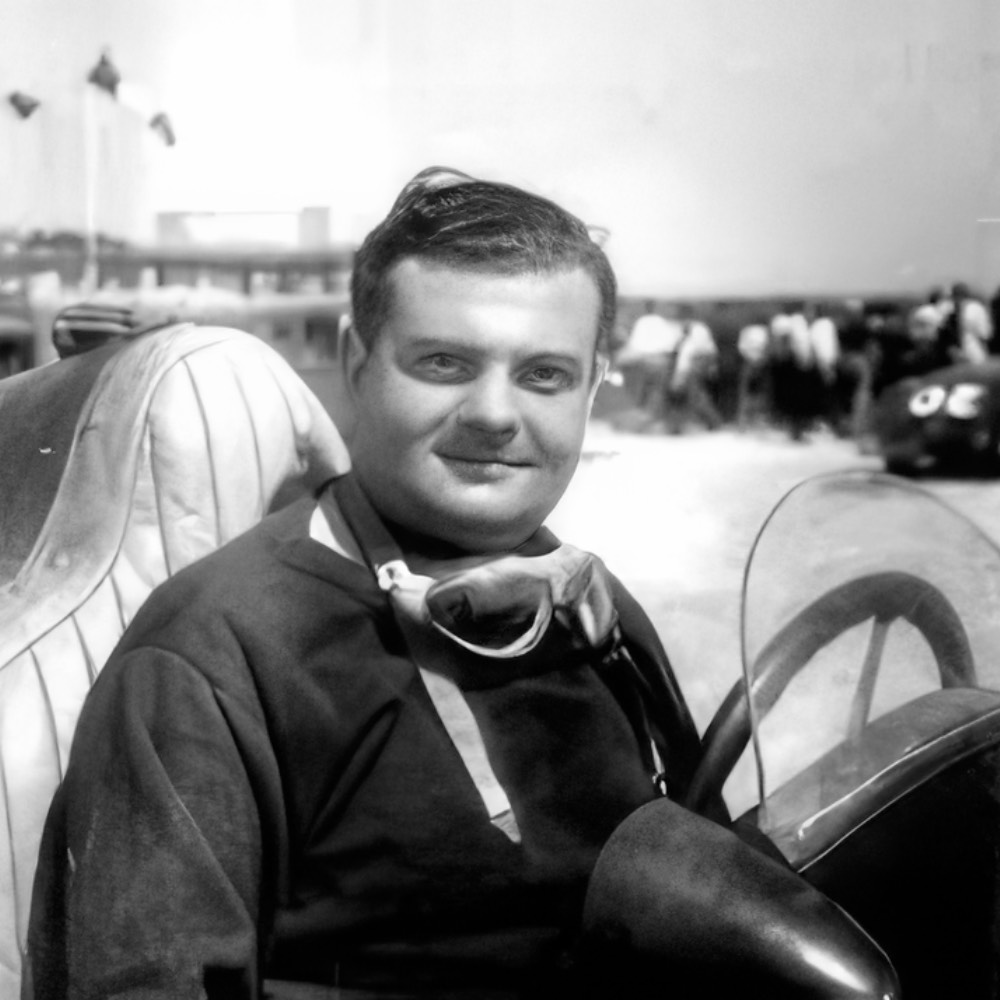
Marcel Balsa
Career Statistics
Biography
Marcel Lucien Balsa (1 January 1909 - 11 August 1984): French racing driver and later sports car dealer from Creuse who participated in one Formula One World Championship Grand Prix, the 1952 German Grand Prix at the Nürburgring, retiring after six laps. Balsa is better remembered for his success in French national racing during the late 1940s and early 1950s, particularly with a Bugatti Type 51, and for later running a successful sports car dealership and even returning to motorsport as an entrant at the 1970 24 Hours of Le Mans. Born on New Year's Day 1909 in Creuse, a rural department in central France, Balsa began his racing career after World War II when he was already approaching 40 years old.
His late start was typical of many French racers whose careers had been interrupted by the war. Balsa acquired a Bugatti Type 51, one of the great French racing cars of the 1930s, and became quite competitive in French national events during the late 1940s. The Type 51 was outdated by postwar standards but remained competitive in national racing, and Balsa's performances earned him a reputation as a capable driver. Seeking to modernize his equipment, Balsa later built a BMW-engined Formula 2 car, demonstrating engineering ambition beyond simply buying existing machinery.
The car earned him a good reputation in French racing circles for both speed and innovation. However, Balsa then switched to a Jicey-BMW developed by Jean Caillas, a more radical design. In 1952, Balsa competed in the Grand Prix of Cadours with the Jicey-BMW, finishing third on the podium. However, the race is remembered for tragedy—fellow French driver Raymond Sommer, one of France's greatest racing drivers, was killed during the event when his Cooper suffered a suspension failure.
Sommer's death at age 55 shocked French motorsport and cast a shadow over Balsa's podium finish. For the 1952 German Grand Prix at the Nürburgring on 3 August, Balsa returned to his previous BMW-engined Formula 2 special and entered the race. The 1952 and 1953 Formula One World Championships used Formula 2 regulations due to insufficient interest in the original Formula 1 rules, meaning Balsa's F2 car was eligible for World Championship competition. Balsa qualified for the race, though near the back of the grid, and took the start among 32 competitors.
However, his race lasted just six laps before he retired with mechanical failure, likely the engine or transmission giving up under the Nürburgring's punishing 14.2-mile Nordschleife layout. His Formula One career consisted of one entry, one start, zero finishes, and zero points. Following his 1952 Nürburgring retirement, Balsa competed in one more significant race in 1953 when he won an event at Montlhéry, the historic French banked oval circuit south of Paris.
The victory at Montlhéry represented the high point of his driving career, but afterward Balsa faded from the racing scene as a competitor. Balsa stopped driving in the mid-1950s as he approached his late 40s, an age when most drivers retired. However, his involvement with motorsport continued through different channels. He established a sports car dealership, capitalizing on his motorsport connections and knowledge to build a successful business selling exotic and performance cars to enthusiasts.
His dealership thrived through the 1960s, and Balsa became a well-known figure in French automotive circles. Remarkably, in 1970, at age 61, Balsa returned to motorsport as an entrant at the 24 Hours of Le Mans, entering a car for other drivers to race. While he did not drive himself, his return to Le Mans demonstrated his enduring passion for the sport and his continued connections within the endurance racing community. The entry made Balsa one of the oldest team owners at Le Mans that year.
Balsa lived to the age of 75, passing away on 11 August 1984 in Maisons-Alfort, a suburb of Paris. His death received limited coverage, reflecting his minor status in international motorsport, though French historic racing publications noted his passing and celebrated his contributions to postwar French racing. Known for his late start in racing, success with a Bugatti Type 51 in French national events, engineering ambition in building his own cars, post-racing career as a sports car dealer, and return to Le Mans as an entrant at age 61, Marcel Balsa represents the generation of French racers who rebuilt the country's motorsport scene after World War II. While his single Formula One start yielded no success, his broader career spanning driving, engineering, and business demonstrates a life fully engaged with automobiles and competition.