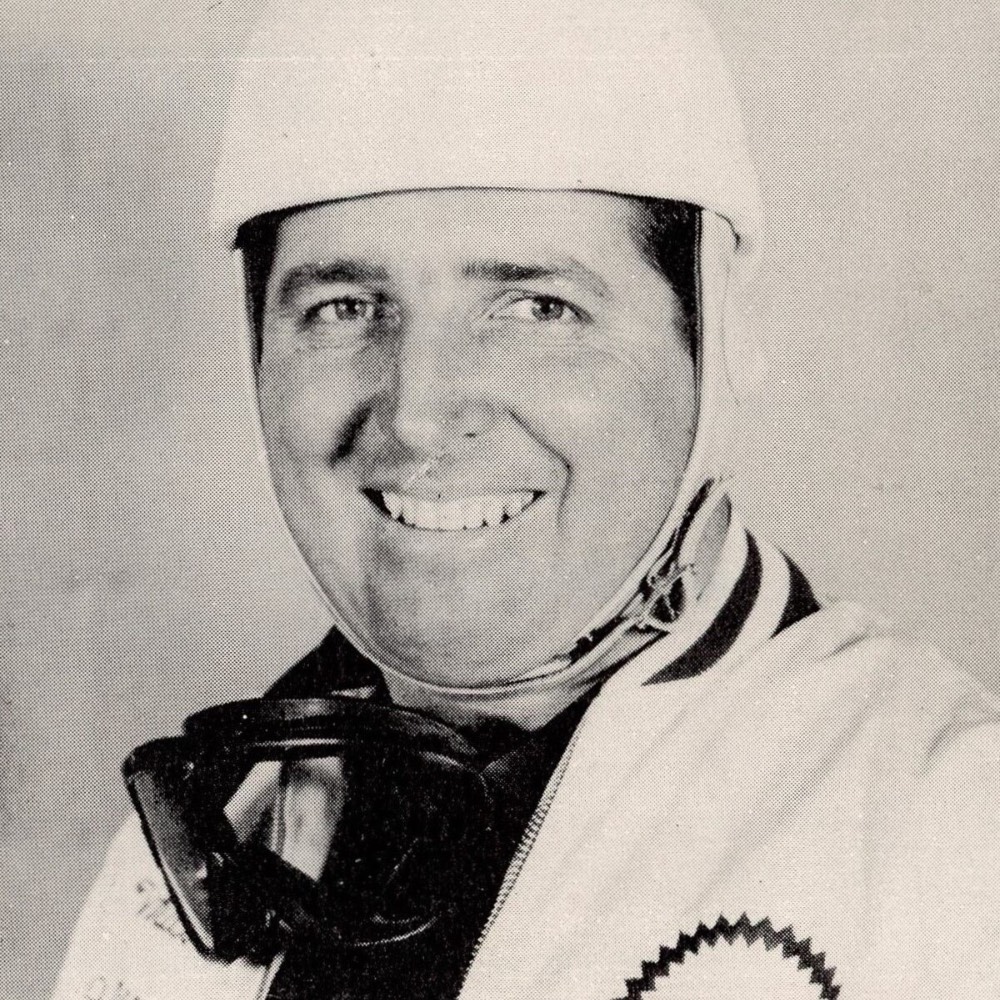
Marshall Teague
Career Statistics
Biography
Marshall Pleasant Teague (22 February 1921 - 11 February 1959): American racing driver from Daytona Beach, Florida, nicknamed 'King of the Beach' for his performances at the Daytona Beach Road Course. Teague competed in 23 NASCAR Grand National Series races from 1949 to 1952, winning seven, and made two Indianapolis 500 starts in 1953 and 1957 (which counted toward the Formula One World Championship), finishing seventh in 1957. Teague was killed at age 37 while attempting to break the closed-course speed record at the newly-built Daytona International Speedway, becoming the track's first fatality. Born in Daytona Beach during the city's emergence as America's motorsport capital, Teague grew up surrounded by racing.
The Daytona Beach Road Course—a 4.1-mile circuit combining beach sand and paved highway—hosted stock car races from the 1930s onward, and Teague watched these events as a boy, dreaming of competing. Teague began racing in the late 1940s and quickly established himself as one of NASCAR's early stars. During the 1951 and 1952 seasons, he was a member of the Hudson Motors factory team, driving the legendary 'Fabulous Hudson Hornet' stock cars.
This partnership is generally regarded as the first stock car racing team backed by a Detroit auto manufacturer, a historic development that established the model of factory support that NASCAR would depend on for decades. Teague's Hudson Hornets dominated NASCAR competition during 1951-1952, with their low center of gravity and superior handling making them nearly unbeatable on road courses and short tracks. Teague won seven NASCAR Grand National races and became one of the sport's biggest names. His success made him a hero in Daytona Beach and earned him the nickname 'King of the Beach' for his performances on the local beach-road course.
Beyond NASCAR, Teague competed at the Indianapolis 500, where his 1953 and 1957 starts counted toward the Formula One World Championship (the Indy 500 was part of the F1 championship from 1950-1960). In 1953, he failed to finish due to mechanical issues, but in 1957 he brought his car home in seventh place, completing the full race distance and earning a respectable result. His Indianapolis performances demonstrated his versatility beyond stock cars. As NASCAR evolved during the 1950s and moved away from the beach course toward purpose-built speedways, Teague remained one of the sport's leading figures.
When Daytona International Speedway was constructed in 1958-59 to replace the beach course, featuring 31-degree banking and a 2.5-mile tri-oval layout, Teague was eager to compete on the new track. In early February 1959, Daytona International Speedway was preparing for the inaugural Daytona 500, scheduled for 22 February 1959—which would have been Teague's 38th birthday. Before the race, Teague decided to attempt to break the closed-course speed record using a streamlined car.
On 9 February, Teague clocked an unofficial lap at 171.821 mph (276.5 km/h), markedly improving Ed Elisian's previous 148 mph record for an American race track. Encouraged, Teague planned further attempts. On 11 February 1959, just 11 days before the first Daytona 500 and 11 days shy of his 38th birthday, Teague was attempting another speed record run when disaster struck. His streamlined car spun entering turn three, flipped, and tumbled violently.
Teague was thrown from the car, still strapped in his seat, and landed on the track surface. The impact was catastrophic, and Teague died almost instantly from massive trauma. He was 37 years old. Teague became the first fatality at Daytona International Speedway, a grim milestone for the track that would host countless races over the following decades. His death cast a pall over the inaugural Daytona 500, held eleven days later.
NASCAR and track officials mourned one of the sport's pioneers and most popular drivers. Teague's death also highlighted the dangers of speed record attempts, where drivers pushed equipment beyond race conditions without the safety equipment or protocols that would develop in later decades. The streamlined car he was driving was experimental and likely aerodynamically unstable at the speeds he was attempting. Teague left behind a significant legacy in NASCAR history.
His factory-backed Hudson team established the template for manufacturer involvement that would define the sport. His seven victories and dominant performances during 1951-1952 helped build NASCAR's credibility and audience during its formative years. Beyond statistics, Teague's story inspired the character Doc Hudson in Pixar's 2006 animated film 'Cars.' Doc Hudson, voiced by Paul Newman, drives a Fabulous Hudson Hornet #51 (Teague's number) and is based on Teague's career and the legendary Hudson racing program.
The character introduced Teague's legacy to a new generation, ensuring his memory endures. Known for his 'King of the Beach' nickname, success with the Fabulous Hudson Hornet factory team, pioneering role in manufacturer-backed NASCAR racing, and tragic death at Daytona International Speedway, Marshall Teague represents NASCAR's formative era when the sport transitioned from beach courses to modern speedways. His death just days before the inaugural Daytona 500 remains one of the sport's great tragedies.