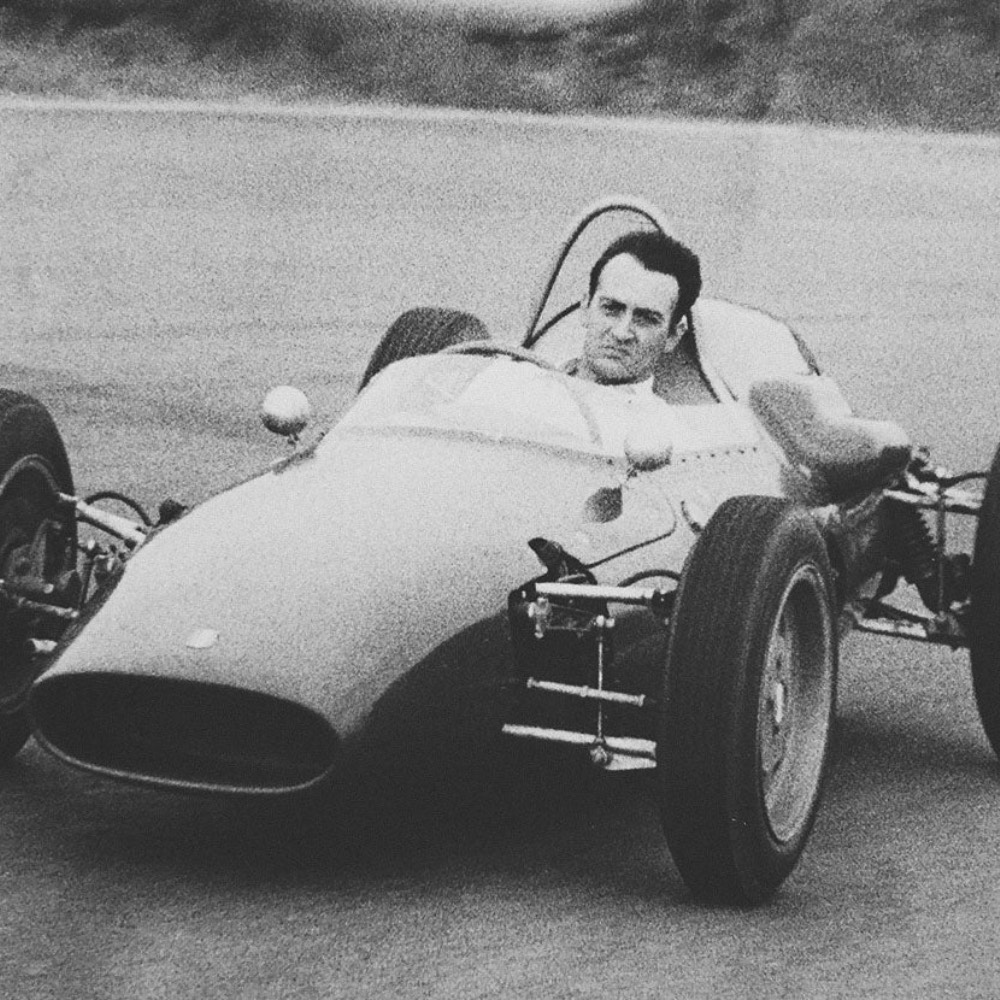
Alejandro de Tomaso
Career Statistics
Biography
Alejandro de Tomaso (10 July 1928 - 21 May 2003): Argentine-Italian racing driver, engineer, and automotive entrepreneur who participated in two Formula One World Championship Grands Prix, debuting on 13 January 1957 and scoring no championship points, but whose lasting legacy came from founding De Tomaso Automobili and building an automotive empire. Born in Buenos Aires, de Tomaso was the son of Italian-born politician Antonio de Tomaso and the daughter of one of Argentina's most prominent and wealthy ranching families. After his father's premature death, Alejandro left school to run the family ranch. He married his first wife, Lola Guiraldes, with whom he had three sons.
From an early age, de Tomaso's great passion had been racing cars. As a young man, de Tomaso was politically active and backed an underground political newspaper opposing President Perón. In 1955 he returned to Buenos Aires to take part in an attempt to overthrow the regime, but when this failed he was forced to leave Argentina and politics for good. In 1954 he competed in the 1000km race of Buenos Aires, finishing well in his class together with co-driver Reyes in a 2-litre Maserati A6GCS.
Arriving in Italy from Argentina in 1954 to continue his racing career, de Tomaso settled in Bologna in 1955 and secured a role as a test driver for O.S.C.A. (founded by the Maserati brothers). During his OSCA years in 1956, Alejandro met American heiress Elizabeth 'Isabelle' Haskell, granddaughter of William C.
Durant, one of the founders of General Motors. The two were soulmates and married in 1957. Isabelle herself was a very capable racing driver, and together they raced successfully in OSCA sports cars from 1956-1958. De Tomaso participated in two Formula One World Championship Grands Prix in 1957 and 1959, scoring no points, but his racing career was secondary to his entrepreneurial ambitions. In 1959 he founded De Tomaso Automobili SpA (later De Tomaso Modena), initially building prototypes and racing cars, including a Formula One car for Frank Williams's team in 1970.
Starting in 1963, De Tomaso Modena built high-performance sports cars using aluminium backbone chassis, which became the company's technical trademark. Notable De Tomaso sports cars included the Vallelunga (1963), Mangusta (1966), Pantera (1971)—which became the company's most famous and successful model with over 7,000 built—and Guarà (1993). De Tomaso Modena also produced luxury cars including the Deauville (1971) and Longchamp (1972). During the 1960s and 1970s under Alejandro's leadership, De Tomaso Modena acquired numerous Italian industrial holdings, creating a significant automotive empire.
These acquisitions included the Ghia and Vignale coachbuilding studios, the Benelli and Moto Guzzi motorcycle firms, the Innocenti car company (founded as an offshoot of the British Motor Corporation to build Minis in Italy), and in 1975, the celebrated sports car maker Maserati, which he rescued from bankruptcy. His business acumen and connections with American automotive interests, particularly through his wife's family, enabled these acquisitions. The Pantera, built in collaboration with Ford and sold through Lincoln-Mercury dealerships in the United States, became De Tomaso's commercial success story. In 1993 Alejandro suffered a stroke and withdrew from public life.
He died on 21 May 2003 in Modena, Italy at age 75. The company moved to the hands of his son Santiago and his wife Isabelle, but went into liquidation in 2004, ending the De Tomaso automotive era. Known for his charisma, business savvy, political connections, and determination to build an Italian automotive brand that could compete internationally, de Tomaso's legacy lives on through the thousands of Panteras still on the road and his contributions to preserving Italian automotive heritage by acquiring struggling brands. While his Formula One driving career was brief, his impact on the automotive industry was significant and lasting.