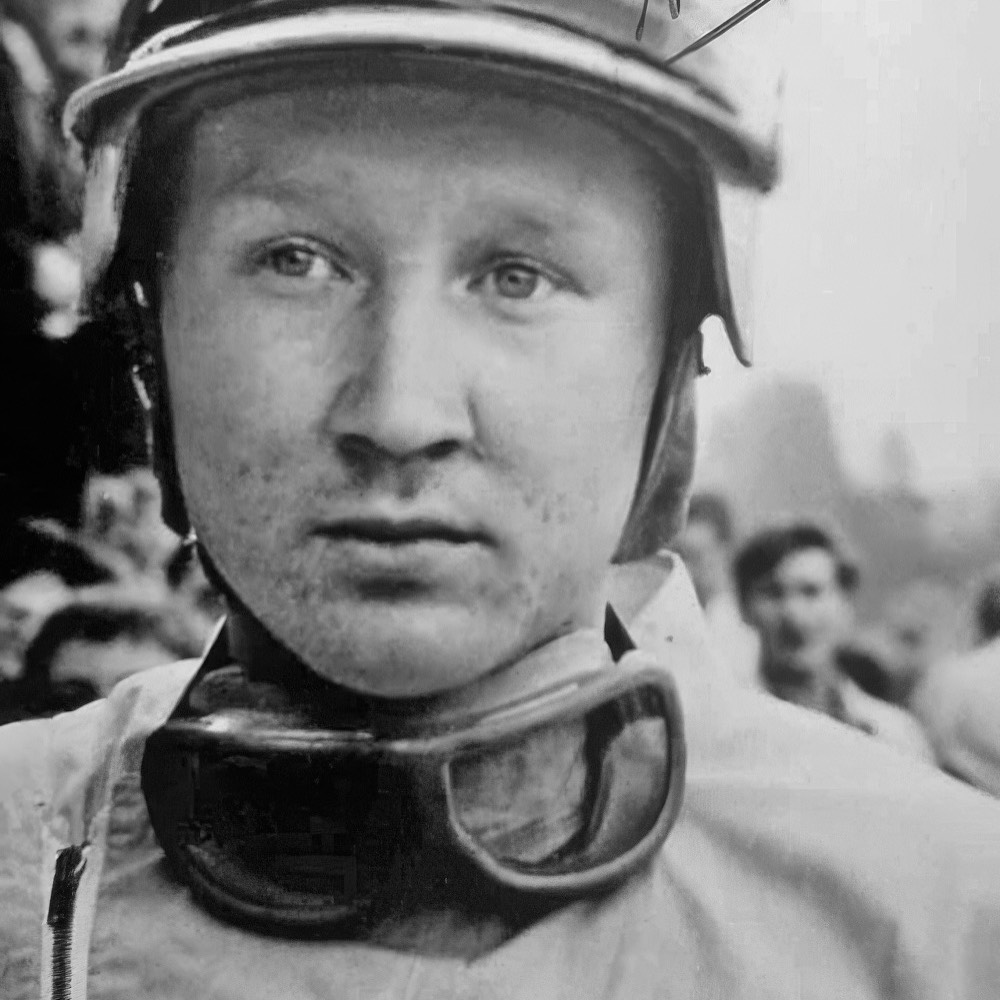
Mike Taylor
Career Statistics
Biography
Michael John Clifford Taylor (24 April 1934 - 4 April 2017): British racing driver from Finchampstead, Berkshire who participated in two Formula One World Championship Grands Prix in 1959 and 1960, scoring no championship points. Taylor's career was effectively ended when he suffered catastrophic injuries in a crash at the 1960 Belgian Grand Prix caused by steering column weld failure on his Lotus 18. He successfully sued Lotus and recovered but never returned to competitive racing. Born in Finchampstead, Taylor was educated at Wellington College, a prestigious English public school.
He was the son of a Mercedes car salesman who founded the dealership Taylor & Crawley in Mayfair, London's most exclusive district. The family's automotive business connections gave Taylor access to cars and racing opportunities from a young age. Taylor started racing with an MG TC, the classic British sports car. At a Silverstone meeting in 1953, he achieved a win plus third and fourth place finishes, demonstrating immediate competitiveness.
He progressed to a Jaguar SS100 and then to a Lotus 7 in 1957, though the Lotus 7 was not competitive in period racing. Taylor's father, concerned about his son's racing expenses and lack of success, bought him a new Lotus Eleven in 1958 but stated it would be sold if Taylor did not finish on the podium in one of his first three races. The ultimatum focused Taylor's efforts. The Lotus Eleven was prepared by Innes Ireland, who would later become a Formula One winner.
With proper preparation, Taylor began making a name for himself, winning club races and achieving two second-place results and two victories at Mallory Park. He finished tenth at the British Empire Trophy at Oulton Park, a significant result that justified keeping the car. Taylor made his Formula One debut at the 1959 British Grand Prix at Aintree on 18 July, driving his own Lotus. He qualified near the back and started the race but sustained transmission troubles, retiring without finishing.
The DNF was disappointing but not unusual for a privateer in an under-supported car. Taylor's second and final Formula One race came at the 1960 Belgian Grand Prix at Spa-Francorchamps on 19 June, one of motorsport's most dangerous circuits. During the race, the steering column weld on Taylor's Lotus 18 failed catastrophically, causing complete loss of steering control at high speed. Taylor's car crashed violently, and he sustained horrific injuries: he broke his back, neck, both legs, both arms, and punctured a lung.
The injuries were life-threatening, and Taylor's survival was uncertain. He spent months in hospital undergoing multiple surgeries and intensive rehabilitation. Taylor eventually recovered physically, though he suffered lasting effects from the injuries. More significantly, he successfully sued Lotus for negligence, claiming the steering column weld failure resulted from poor manufacturing quality control.
The lawsuit was one of the early legal cases in motorsport where a driver successfully held a manufacturer accountable for mechanical failure causing injury. Taylor won the suit and received compensation, but the crash effectively ended his racing career. He was just 26 years old when his career ended at Spa. Following his recovery, Taylor remained connected to motorsport through historic racing and occasional appearances, but he never returned to competitive racing at the level he had aspired to before the crash.
The physical and psychological trauma of the Spa accident, combined with his lawsuit against Lotus, made continuing in frontline motorsport impossible. Taylor lived to age 82, passing away on 4 April 2017, just weeks before his 83rd birthday. His death received coverage in British motorsport publications, with obituaries focusing on the Spa crash and his successful lawsuit against Lotus rather than his two Formula One starts. The case became significant in motorsport legal history as an early example of driver litigation against manufacturers for safety failures.
Known for his two Formula One starts (1959 British and 1960 Belgian GPs), catastrophic crash at 1960 Belgian Grand Prix caused by steering column weld failure, life-threatening injuries including broken back, neck, both legs and arms and punctured lung, successful lawsuit against Lotus for manufacturing negligence, and career-ending consequences of the crash at age 26, Mike Taylor represents drivers whose careers were ended not by lack of talent but by mechanical failures and manufacturer negligence. His successful lawsuit helped establish that manufacturers could be held accountable for safety failures, contributing to gradual improvements in motorsport safety standards.