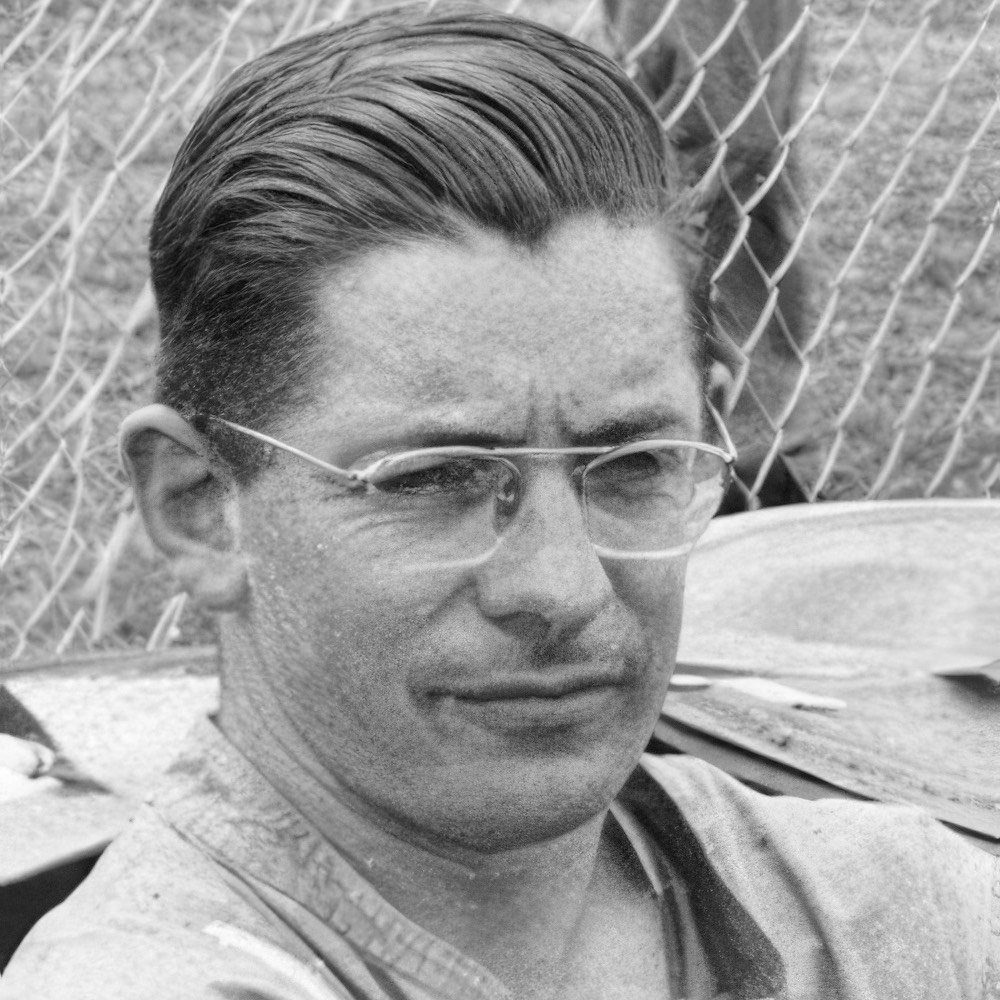
Paul England
Career Statistics
Biography
Paul England (28 March 1929 - 17 June 2014): Australian racing driver and engineer from Melbourne, Victoria who participated in one Formula One World Championship Grand Prix, the 1957 German Grand Prix, driving a Cooper T41-Climax in the Formula Two class, but who achieved far greater success as an engineer at Repco, a hillclimb specialist winning three Australian Hillclimb Championships (1970, 1973, 1974), and as the builder of the innovative Ausca sports racing car. Born in Melbourne, Victoria on 28 March 1929, England developed his passion for engineering and motorsport from an early age, combining both interests into a career that spanned engineering innovation and competitive driving. In the mid-1950s, England worked for Repco (Replacement Parts Company), one of Australia's largest automotive parts manufacturers, where he worked alongside legendary engineer Phil Irving, who would later design the Repco V8 engine that powered Jack Brabham to the 1966 Formula One World Championship.
During his time at Repco, England applied his engineering knowledge to building his own racing car. In the mid-1950s, England built a sports racing car called the Ausca, featuring a fiberglass body based on the beautiful Maserati A6GCS design, powered by a Holden six-cylinder 'grey motor' (the Holden 138 cubic inch inline-six) fitted with a Repco cylinder head designed by Phil Irving. This combination of Australian production engine with specialized Repco performance parts created a competitive sports car that England raced successfully in Australian national competition, demonstrating both his engineering skill and driving ability. In 1957, England traveled to Europe for what he described as a 'motor racing holiday,' purchasing a Cooper T41-Climax Formula Two car to compete in European races.
The Cooper T41, while not a front-line Formula One car, was competitive in Formula Two and could also enter Formula One World Championship races in the F2 class, which several Grands Prix accommodated on the grid alongside the full Formula One entries. England competed in several Formula 2 races during his European sojourn, achieving consistent results. On 6 July 1957, entered under the Colonial Equipe banner, he finished eighth in both heats and eighth overall in the BRSCC Formula 2 race at Mallory Park. Eight days later, on 14 July 1957, he competed at Reims for the Coupe Internationale de Vitesse, finishing eighth again.
His Formula One World Championship opportunity came at the 1957 German Grand Prix at the Nürburgring Nordschleife on 4 August 1957, where he entered his Cooper T41-Climax under the Ridgeway Managements banner in the Formula Two class. Several Formula Two cars were permitted to start the race alongside the Formula One entries, though they competed for separate classification and were not eligible for World Championship points. England qualified his Cooper and started the race, but unfortunately retired with mechanical failure, his German Grand Prix adventure ending without a finish. This would be England's only Formula One World Championship race entry, though he continued competing in non-championship Formula 2 events for the remainder of his European trip before returning to Australia.
Back in Australia, England concentrated on hillclimbing, a discipline particularly popular in Australia where drivers race individually against the clock up mountain roads featuring tight corners, steep gradients, and minimal safety barriers. He built another innovative Ausca, this time a twin-engined Volkswagen hillclimb special featuring remarkable engineering: a VW flat-four engine at each end of the car, with each engine driving its own pair of wheels—the front engine approximately 1800cc also drove a supercharger that fed both engines, while the rear engine was approximately 2200cc. This all-wheel-drive, twin-engined, supercharged monster represented radical thinking for hillclimb competition and demonstrated England's engineering creativity.
England's hillclimb success was extraordinary: he won the prestigious Australian Hillclimb Championship three times in 1970, 1973, and 1974, establishing himself as one of Australia's finest hillclimb drivers and cementing his legacy in Australian motorsport. These championship victories came against fierce competition and demonstrated his consistent pace and car control over many years. England also competed in the Bathurst endurance race three times when it was held at the Phillip Island circuit. In 1960, co-driving with Bruce Walton in an NSU Prinz, they finished second in class and 26th overall.
The following year, sharing a Triumph Herald with Hoot Gibson, they were disqualified for receiving illegal assistance from a mechanic during the race. In 1962, Gibson, England, and Jack Madden drove a Triumph Herald to seventh in class and 19th overall, demonstrating England's versatility across different forms of motorsport. After leaving Repco in the late 1950s, England established his own engine balancing business called 'Paul England & Staff' in Essendon, Victoria, Australia. This business specialized in precision engine balancing, blueprinting, and performance preparation, services essential for racing engines.
The business became highly respected in Australian motorsport circles, with many leading teams and drivers utilizing England's engineering expertise for their race engines. England continued operating this business for many years, combining his engineering knowledge with his racing experience to provide valuable services to the Australian motorsport community. Paul England passed away on 17 June 2014 at age 85 in Australia, having lived a full life combining engineering innovation with competitive motorsport success. His legacy includes his innovative Ausca sports and hillclimb cars, his three Australian Hillclimb Championships, his engineering work at Repco alongside Phil Irving, and his engine balancing business that served Australian motorsport for decades.
Known for being a talented engineer who built his own innovative racing cars, for his three Australian Hillclimb Championships, for his remarkable twin-engined supercharged Ausca hillclimb special, for his work at Repco alongside Phil Irving, and for his single Formula One appearance at the 1957 German Grand Prix, Paul England represents the combination of engineering brilliance and driving talent that characterized many Australian motorsport figures of the 1950s-1970s era.