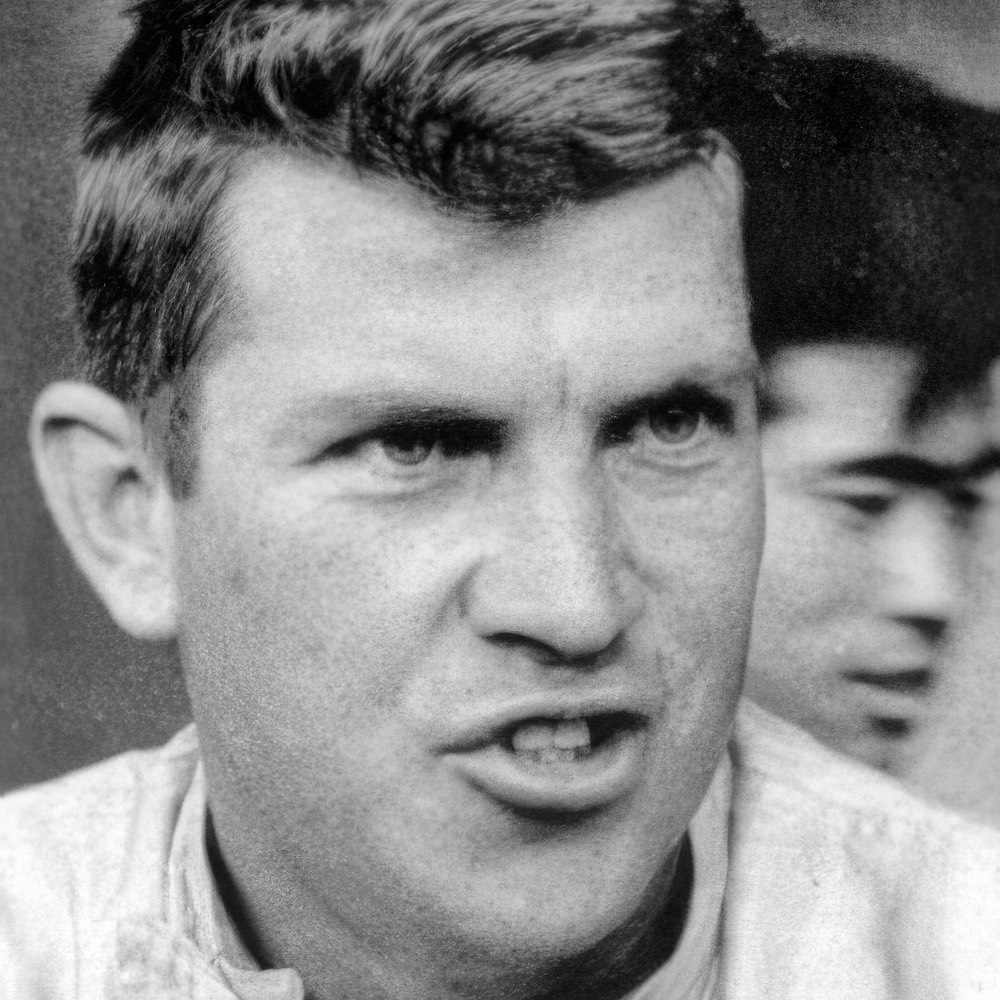
Ronnie Bucknum
Career Statistics
Biography
Ronald David 'Ronnie' Bucknum (5 April 1936 - 23 April 1992) was an American racing driver who competed in 11 Formula One World Championship Grands Prix from 1964 to 1966 as Honda's first Formula One driver, scoring two championship points while achieving greater success in sports car racing including third place at the 1966 24 Hours of Le Mans. Born in Alhambra, California, on 5 April 1936, Bucknum initially worked as a land surveyor before taking up motorsport in 1957 at age 21. His progress in sports car racing proved so rapid and impressive that he soon abandoned surveying to race full-time, demonstrating natural talent that quickly elevated him to national-level competition. Throughout the late 1950s and early 1960s, Bucknum dominated American sports car racing, winning Sports Car Club of America (SCCA) titles in 1959, 1960, 1962, and 1964—an extraordinary record of success that established him as one of America's finest sports car drivers.
His statistics from this period were remarkable: 44 victories in 48 races, an approximately 92% winning percentage that ranks among the highest in American motorsport history. This sustained success made Bucknum a prominent figure in American club racing, though he remained largely unknown internationally. Bucknum's life changed dramatically when Honda engineers observed him racing a Porsche 904 at the 12 Hours of Sebring. Impressed by his smooth driving style and pace, Honda made an unusual decision: they selected Bucknum to debut their new Formula One program.
The logic was convoluted but reflected Honda's thinking—since the Japanese manufacturer had no Grand Prix racing experience, it made sense to hire a driver of corresponding status rather than an established Formula One star who might struggle to adapt to an inexperienced team's limitations. On 2 August 1964 at the German Grand Prix at the Nürburgring, Bucknum became the first driver to pilot a Honda-engined car in Formula One, debuting the RA271. Remarkably, this represented Bucknum's first-ever single-seater race—he had never competed in Formula 2, Formula 3, or any junior single-seater category, moving directly from sports car racing to Formula One in one giant leap. This unprecedented jump demonstrated both Honda's unusual approach and Bucknum's adaptability, though it meant he faced an enormous learning curve.
Bucknum's debut season with Honda in 1964 provided invaluable development experience for the Japanese manufacturer, though results were modest as the team learned Formula One's demands. Throughout 1965, Bucknum continued developing the Honda RA272 alongside teammate Richie Ginther, gradually improving the car's competitiveness. At the 1965 Mexican Grand Prix at Mexico City, Bucknum achieved his sole World Championship points, finishing fifth in a race won sensationally by his teammate Ginther—Honda's first-ever Grand Prix victory. Bucknum's fifth place earned him two championship points and demonstrated that Honda's program was progressing, though his result was overshadowed by Ginther's historic triumph.
Bucknum remained with Honda through 1966, competing in their final Formula One season before the manufacturer withdrew from Grand Prix racing. Over 11 World Championship starts from 1964-1966, Bucknum scored two championship points—modest statistics that don't reflect the pioneering nature of his role as Honda's first Formula One driver or the challenges of competing with an inexperienced team. Beyond Formula One, Bucknum achieved his greatest racing success in sports car competition. In 1966, he drove a Carroll Shelby-entered Ford GT40 Mk II to third place at the 24 Hours of Le Mans, finishing on the podium at motorsport's most prestigious endurance race.
This result represented Bucknum's career highlight, demonstrating his exceptional endurance racing abilities and pace when provided with competitive equipment. After Honda withdrew from Formula One, Bucknum transitioned to USAC Championship Car racing (the series that included the Indianapolis 500), competing from 1967-1970 with 23 starts. His IndyCar career included three Indianapolis 500 appearances from 1968-1970, though he never achieved strong results at the Brickyard. However, in 1968, Bucknum won the Michigan 500 at Michigan International Speedway, scoring his first and only major American open-wheel victory and demonstrating his versatility across different racing disciplines.
Throughout his post-Formula One career, Bucknum continued occasional sports car appearances while focusing primarily on IndyCar competition. He was the father of Jeff Bucknum, who would later compete in the Indy Racing League and American Le Mans Series, continuing the family's motorsport legacy into the next generation. Ronnie Bucknum passed away on 23 April 1992 in San Luis Obispo, California, at age 56 after a long battle with a diabetes-related illness. Though his Formula One career consisted of 11 races with just two championship points, Bucknum's significance extends beyond statistics—he served as Honda's pioneering Formula One driver, helping the Japanese manufacturer take its first steps in Grand Prix racing that would eventually lead to Honda becoming one of Formula One's most successful engine suppliers.
His third place at Le Mans and Michigan 500 victory demonstrate genuine talent that thrived in sports car and IndyCar racing where his smooth, consistent style suited the demands perfectly.