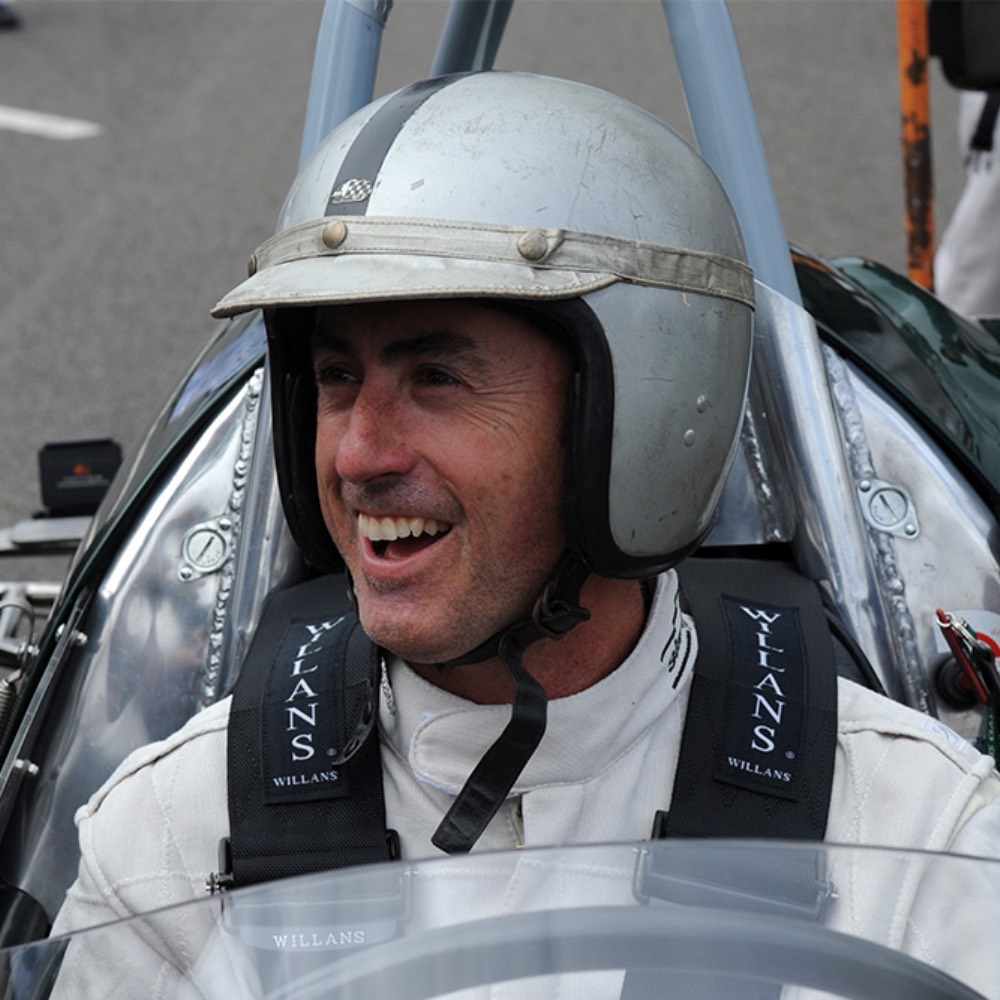
David Brabham
Career Statistics
Biography
David Brabham (born 5 September 1965) is an Australian former racing driver, youngest son of three-time Formula One World Champion Sir Jack Brabham, who competed in Formula One during 1990 and 1994, but achieved his greatest success in sports car racing, winning the 24 Hours of Le Mans overall in 2009 and becoming a two-time American Le Mans Series champion. Born in Wimbledon, England, on 5 September 1965 while his father Jack was competing in Formula One, David grew up as the youngest of the Brabham boys in a household steeped in motorsport history. Despite—or perhaps because of—having a legendary father, David faced enormous expectations as he pursued his own racing career, dealing with constant comparisons to his father's extraordinary achievements.
David's professional racing career began in Australia in 1983 when he started racing karts at age 17, spending two years developing his skills in karting competition. He moved into car racing in 1985 with the Ford Laser series, then progressed to Formula Ford 1600 in 1986, following the traditional single-seater progression path. In 1987, competing in Australian Formula 2, Brabham won the Australian Drivers' Championship, immediately establishing his credentials and suggesting he possessed the talent to follow in his father's championship-winning footsteps. David's next step took him to Britain and the ultra-competitive British Formula 3 Championship, widely regarded as the world's toughest junior single-seater series.
In 1989, driving for Bowman Racing, Brabham dominated the championship, winning six races throughout the season and capping his title-winning campaign with victory in the prestigious Macau Grand Prix—the traditional end-of-season Formula 3 showcase. This British F3 title and Macau victory marked Brabham as one of motorsport's hottest properties, and Formula One opportunities beckoned. Brabham's Formula One break came in 1990 when he joined the Brabham team—the team his father had founded in 1960 and which bore the family name. However, the romantic notion of a Brabham racing for Brabham quickly dissolved into disappointment.
By 1990, the once-great team had fallen on desperately hard financial times, struggling to compete against better-funded rivals. Brabham made 14 race entries during the 1990 season but managed to qualify the hopelessly uncompetitive Judd-engined Brabham BT58 and BT59 for only six races, failing to pre-qualify eight times. When he did qualify, the car's lack of competitiveness meant he was racing at the back of the field. The 1990 season proved humiliating for both David and the Brabham name, and the team withdrew from Formula One mid-season, unable to continue without adequate funding.
After Brabham's collapse, David spent 1991-1993 competing in various categories, but retained hopes of returning to Formula One with competitive equipment. His opportunity came in 1994 when his father purchased shares in the new Simtek team, securing David a race seat. Despite Simtek being severely under-funded and using year-old Ford engines, Brabham qualified for every race—a considerable achievement given the car's lack of development. His best result came with 10th place at the 1994 Spanish Grand Prix, though this was outside the points.
After Simtek collapsed following the death of driver Roland Ratzenberger at Imola and subsequent financial difficulties, David's Formula One career ended. Over 24 Grand Prix starts across two seasons, Brabham never scored a championship point, though this reflected his uncompetitive machinery rather than his abilities. Freed from Formula One's constraints, Brabham found success in sports car racing that had eluded him in Grand Prix racing. In 1996, he won the Japanese Super GT championship driving a Lark McLaren F1-GTR-BMW alongside John Nielsen, securing his first major international title.
In 1997, he achieved one of Australian motorsport's greatest prizes by winning the Bathurst 1000 touring car race. In 1998, competing with the Panoz racing team, Brabham won a professional Sports Car championship in the United States, establishing himself as one of sports car racing's most versatile and quick drivers. Brabham's greatest achievements came at the 24 Hours of Le Mans, motorsport's most prestigious endurance race. He first won his class at Le Mans in 2007 and 2008, claiming GT1 category victories that demonstrated his prowess in prototype sports car racing.
His crowning achievement came in 2009 when he joined Peugeot Sport Total to drive the #9 Peugeot 908 HDI alongside Marc Gené and Alexander Wurz. The trio dominated the race, securing overall victory and bringing Peugeot their third and final Le Mans triumph. Winning Le Mans overall represented a career-defining achievement—conquering the world's greatest endurance race in a way his father never had, establishing David's own motorsport legacy independent of the Brabham name. Beyond Le Mans, David achieved remarkable success in the American Le Mans Series, winning 23 races across all four classes and securing two championships—the LMP1 title in 2009 and the LMP championship in 2010.
These American Le Mans Series titles, combined with his Le Mans overall victory, established Brabham as one of the world's leading endurance racing drivers of his generation, achieving success that eclipsed his disappointing Formula One career. After retiring from driving, David remained involved in motorsport, attempting to revive the Brabham name through Project Brabham and later Brabham Automotive, seeking to continue his father's legacy through road car production and potential racing programs. While his Formula One career failed to live up to the Brabham name's storied history, David Brabham's extraordinary sports car racing success—particularly his 2009 Le Mans overall victory and American Le Mans Series championships—established him as a champion in his own right, carving out a legacy worthy of the Brabham racing dynasty.