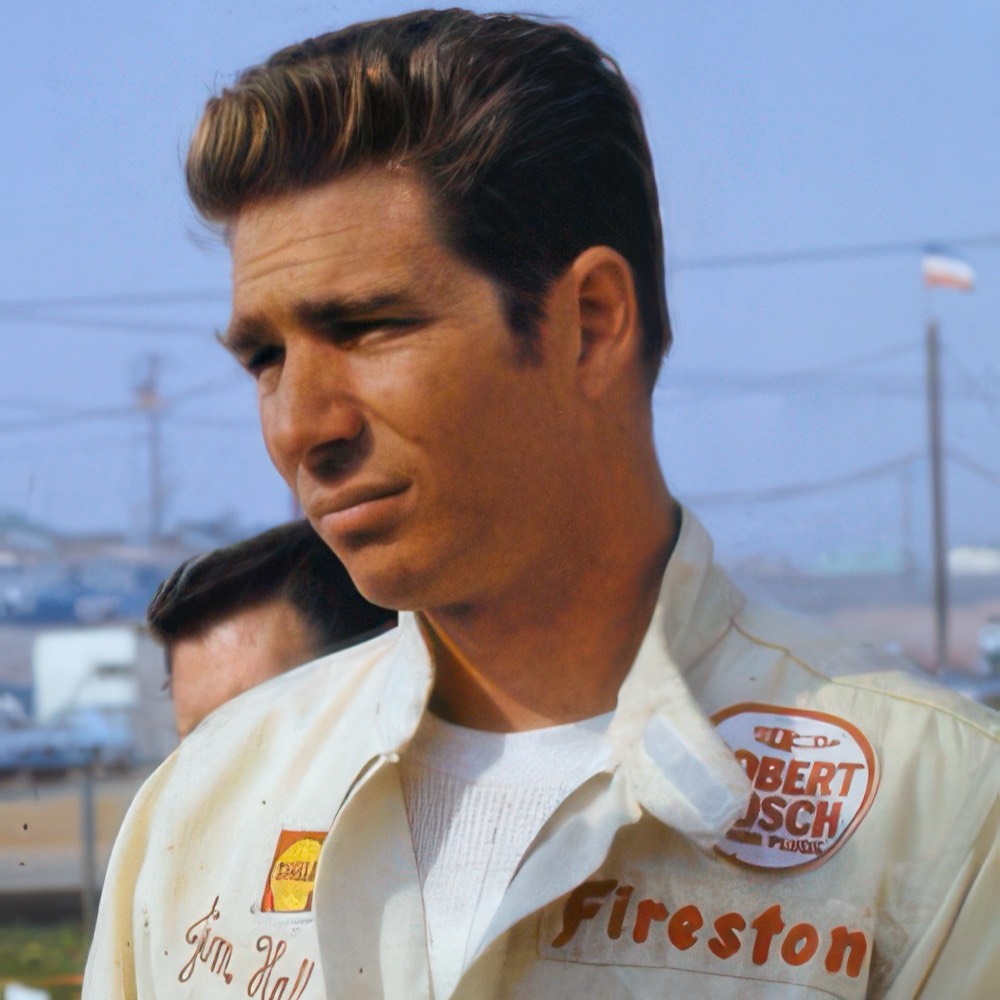
Jim Hall
Career Statistics
Biography
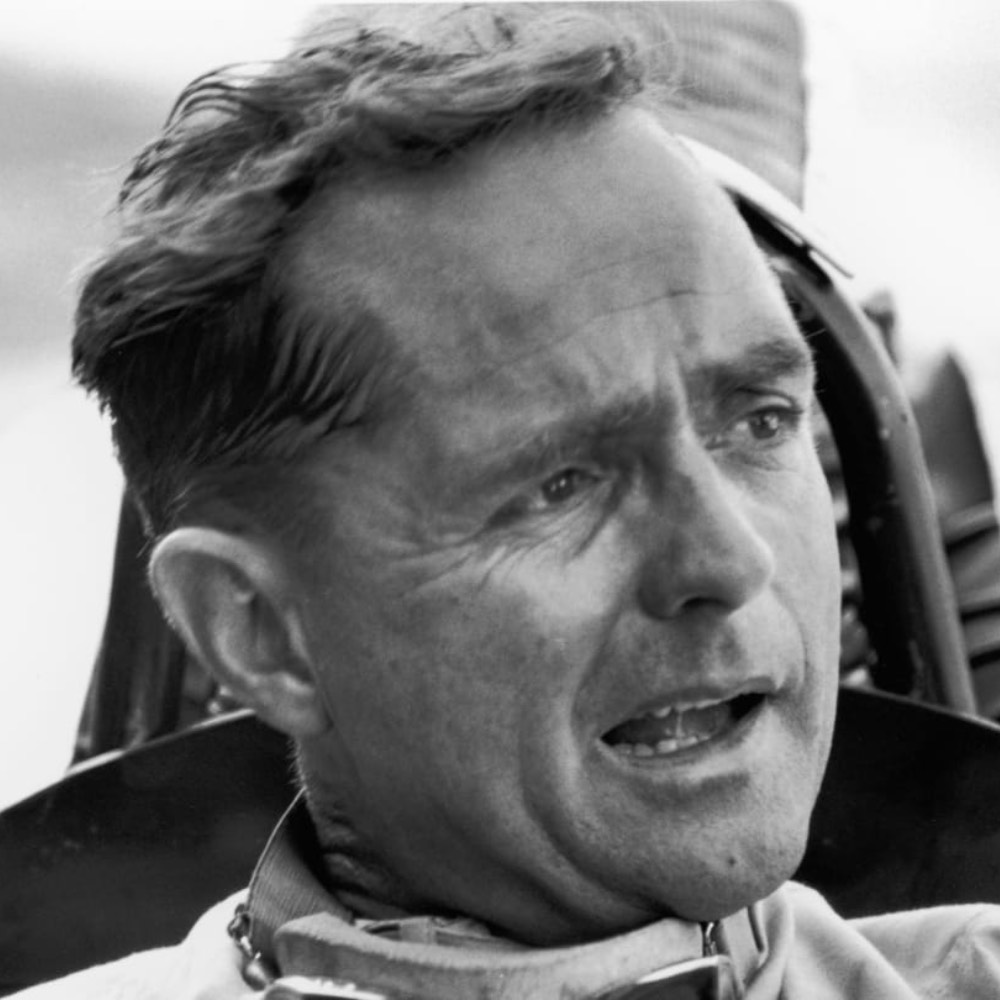
James Ellis Hall (23 July 1935 - Present): American retired racing driver, race car constructor, and team owner. While best known as a car constructor, he was one of the greatest American racing drivers of his generation, capturing consecutive United States Road Racing Championships (1964, 1965), two Road America 500s (1962, 1964), two Watkins Glen Grands Prix for sports cars (1964, 1965), the 1965 Canadian Grand Prix for sports cars, the 1965 Pacific Northwest Grand Prix, and scoring a massive upset at the 1965 12 Hours of Sebring over factory-backed Ford GTs, Shelby Daytona Coupes, and Ferrari entries. He competed in Formula One from 1960 to 1963, participating in 12 Grand Prix and numerous non-championship races.
His outstanding driving performance at the 1962 season-ending Mexican Grand Prix led British Racing Partnership (BRP) to offer him a seat for 1963. Hall accepted, but neither the team nor Hall realized BRP was on the verge of decline. Nevertheless, Hall managed to accumulate three World Championship points with his best finish being fifth in the 1963 German Grand Prix at the Nürburgring, his first time at the fabled track. He retired from Formula One at year's end to concentrate on the Chaparral project.
Hall backed the project and named the vehicle Chaparral, having success with the Chaparral 1 winning the Road America 500 and other races. The first of the true Jim Hall Chaparrals was built in Midland, Texas during 1962 and 1963—at the same time Colin Chapman was building the first monocoque Formula 1 car, Hall was developing a monocoque sports racer of his own design made of composites. A former F1 driver and owner and driving force of Chaparral Cars, he was an early adopter of aerodynamics applied to race cars and the leading proponent of that technology for an entire decade. Hall introduced the world's first constant downforce racecar, the 1970 Chaparral 2J, which used a snowmobile engine to power two fans to reduce air pressure between the car's bottom and the road regardless of vehicle speed.
Today, because of Hall, downforce is part of the design brief for every major form of racing car. In 1968 at the Stardust Can-Am GP in Las Vegas, he ran into the back of Lothar Motschenbacher's McLaren—the Chaparral was destroyed and Hall was hospitalized for nine weeks with multiple injuries which, apart from a couple of Trans-Am races in 1970 with a Camaro, ended his racing career as a driver.