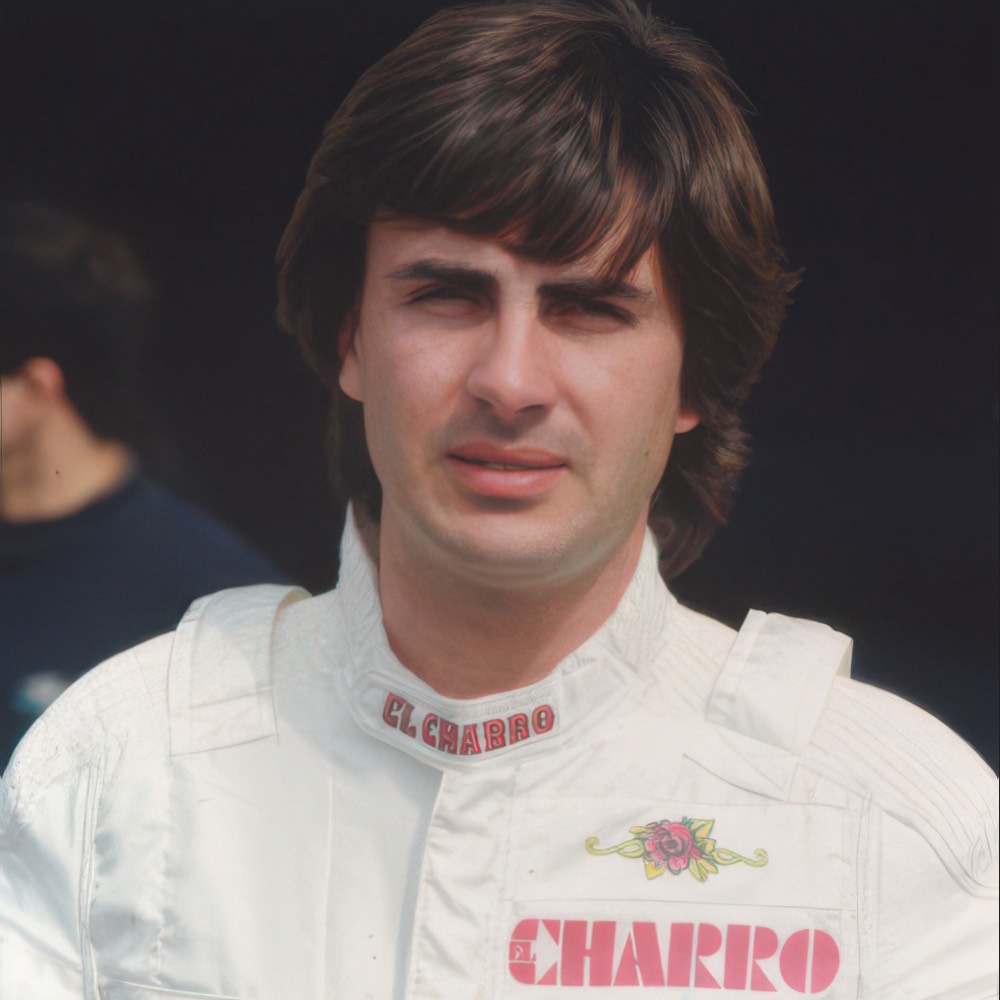
Pascal Fabre
Career Statistics
Biography
Pascal Fabre (9 January 1960 - Present): French racing driver from Lyon who competed in Formula One for the AGS team in 1987, participating in 14 Grands Prix and scoring no championship points with a best finish of ninth place at both the French and British Grands Prix, but who achieved greater success in 1986 by winning the opening round of the International Formula 3000 Championship at Silverstone before his brief Formula One career ended mid-season when the struggling AGS team could no longer accommodate him. Born and raised in Lyon, Fabre began his racing career in French national motorsport during the early 1980s, progressing through junior categories before finding success in Formula 3000, the primary feeder series to Formula One.
In 1985 he competed in the inaugural International Formula 3000 Championship season with moderate results, learning the category and establishing himself among the series' competitive drivers. His breakthrough came in 1986 when he won the first round of the Formula 3000 Championship at Silverstone, driving a Lola-Ford for the Madgwick Motorsport team with pole position, fastest lap, and a dominant victory—a perfect weekend that announced him as a serious Formula One prospect. He finished seventh in the final 1986 Formula 3000 Championship standings, achieving consistent points finishes throughout the season and demonstrating the pace required for Formula One promotion. For 1987, Fabre secured a Formula One drive with AGS (Automobiles Gonfaronnaises Sportives), a small French team based in Gonfaron in the Var department of Provence, founded by Henri Julien and managed by former driver Christian Vanderpleyn.
The AGS JH21C-Cosworth DFZ was not a competitive car, typically qualifying toward the back of the grid, but it proved remarkably reliable, allowing Fabre to gain valuable Formula One experience. Fabre made his Formula One debut at the 1987 San Marino Grand Prix at Imola on 3 May 1987, qualifying 25th and finishing 11th, three laps down but completing the race. Over the opening nine races of 1987, Fabre demonstrated consistency that belied the car's lack of pace—he was classified in eight of the first nine races, an impressive reliability record for a small team with limited resources. His best results came at the 1987 French Grand Prix at Paul Ricard on 5 July 1987, where he finished ninth, and the 1987 British Grand Prix at Silverstone on 12 July 1987, where he again finished ninth.
While these results scored no points (only the top six scored in 1987), they represented solid performances given the equipment, and Fabre's consistency kept him ahead of several other backmarker drivers in the standings. However, as the 1987 season progressed and more teams entered races, making the grid became increasingly difficult. The introduction of pre-qualifying for the slowest teams meant Fabre faced the Friday morning lottery of advancing from pre-qualifying to official qualifying. At the 1987 Hungarian Grand Prix on 9 August 1987, Fabre suffered his first failure to qualify (technically a pre-qualification failure), unable to advance beyond the preliminary session.
Two weeks later at the 1987 Austrian Grand Prix at the Österreichring on 16 August 1987, he again failed to pre-qualify, eliminated before he could even attempt to make the grid. These failures signaled the end of Fabre's Formula One career. AGS, struggling financially and needing to generate income, decided to replace Fabre with paying driver Roberto Moreno for the final races of 1987. Moreno brought sponsorship funding that the team desperately needed, and Fabre was left without a seat despite having performed reasonably well given the circumstances.
His Formula One career ended after 14 race entries, 12 actual starts (two failed pre-qualifications), and zero championship points, though his completion rate of eight classified finishes from 12 starts demonstrated commendable reliability. Following his Formula One disappointment, Fabre transitioned into work as a stunt driver in the film and television industry, utilizing his car control skills and racing experience in a new career path. His work has included driving for various French and international film productions, performing precision driving sequences and coordinating vehicle-based action scenes. This career transition allowed Fabre to continue working with high-performance vehicles while earning a living outside competitive motorsport.
Fabre occasionally appears at historic racing events and Formula One gatherings, representing the era of small French teams like AGS, Ligier, and Larrousse that provided opportunities for French drivers during the 1980s and early 1990s. His single Formula 3000 victory at Silverstone in 1986 remains the highlight of his racing career, demonstrating that on his day, with competitive equipment, he possessed genuine speed. His Formula One career, while statistically unsuccessful, was respectable given the circumstances—he was not embarrassingly slow, completed races reliably, and was only replaced due to financial rather than performance considerations. Known for his consistency in uncompetitive machinery, his transition to stunt driving, and representing the challenges faced by French drivers attempting to break into Formula One with under-resourced teams during the 1980s, Pascal Fabre's career illustrates how talent alone was insufficient in an era when even making the grid required competitive equipment, and how financial pressures often trumped performance in determining driver retention at smaller teams.