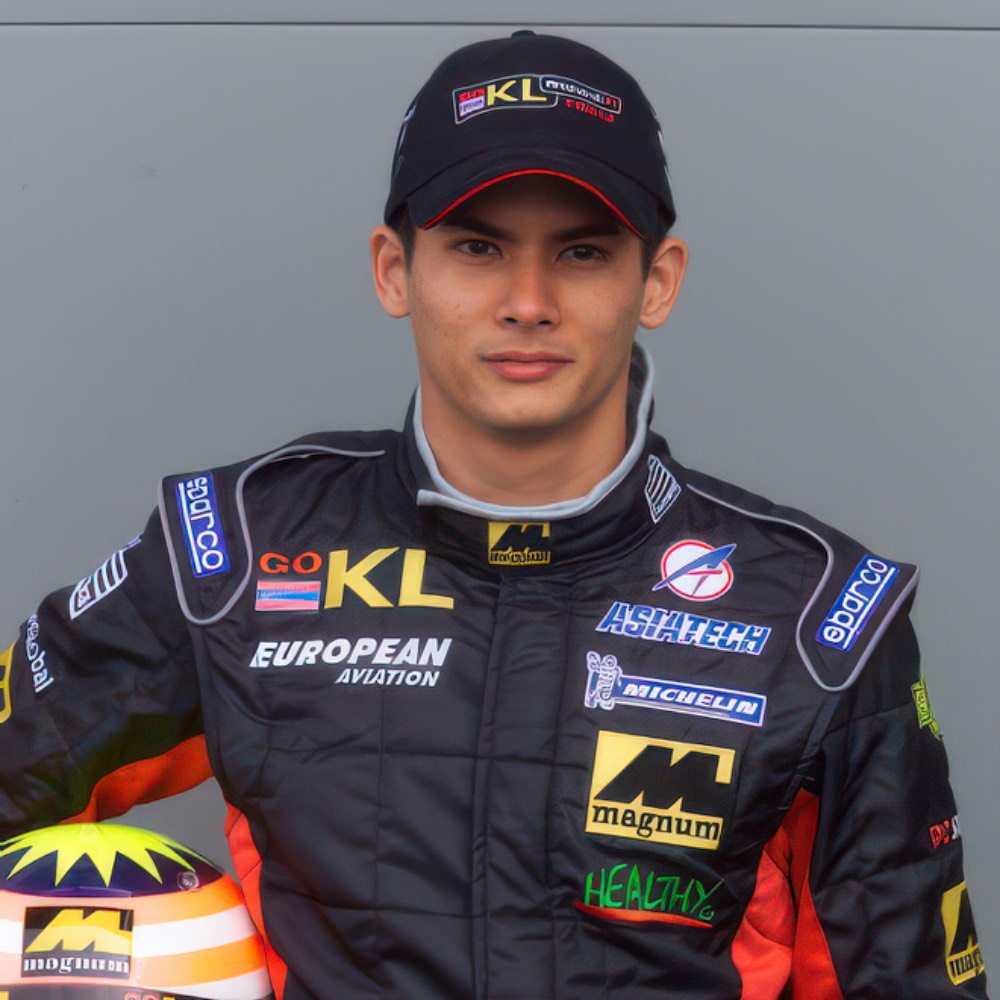
Alex Yoong
Career Statistics
Biography
Alexander Charles Yoong Loong (July 20, 1976 - Present): A Malaysian racing driver who became his nation's first and to date only Formula One competitor, driving for the Minardi team during the 2001 and 2002 seasons in a challenging period that tested his resilience and determination despite limited results. Born on July 20, 1976, in Kuala Lumpur to a Malaysian Chinese father and English mother, Yoong grew up in a multicultural household and developed an early passion for motorsport in a country with limited racing infrastructure or tradition. His racing career began in the Malaysian national championship, which he won in 1995, establishing himself as his country's top young talent. Seeking to develop his skills internationally, Yoong moved to Europe in 1996 to compete in Formula Renault, the traditional starting point for aspiring single-seater drivers.
He progressed through Formula Three before moving to the highly competitive Formula 3000 series, where he showed flashes of speed despite struggling for consistent results. During one Formula 3000 season, Yoong suffered a horrific crash at Spa-Francorchamps but recovered and managed to improve his performances despite the psychological impact of the accident. His opportunity to reach Formula One came through backing from Magnum, the Malaysian government-controlled lottery company, which provided the financial support necessary to secure a Minardi seat. Yoong made his Formula One debut at the Italian Grand Prix in 2001, replacing Tarso Marques for the final three rounds of the season.
Racing alongside his teammate, a young Fernando Alonso who would go on to become a two-time World Champion, Yoong struggled to match the pace of the future superstar. At Suzuka, he finished 16th, three laps down on the leaders, reflecting both his learning curve and the Minardi's lack of competitiveness. For 2002, Alonso departed for Renault, and Yoong found himself paired with Australian rookie Mark Webber, another future Formula One star. At the season-opening Australian Grand Prix, Yoong produced his finest Formula One performance, making a stunning start that saw him running as high as fifth place after overtaking McLaren's David Coulthard.
The paddock watched in amazement as the Malaysian held position before eventually finishing seventh—his best classified result in Formula One, though still outside the points-paying positions in an era when only the top six scored. However, after this promising start, Yoong's season deteriorated dramatically. He spun out in Brazil, failed to qualify within the 107% rule at San Marino (a regulation requiring drivers to lap within 107% of the fastest qualifying time to be allowed to race), and was sidelined at Spain when wing failures affected both Minardi cars during practice. As the season progressed, Minardi's patience wore thin.
The team replaced Yoong with Anthony Davidson for the Hungarian and Belgian Grands Prix, allowing the Malaysian time for preparation before returning for the final three races. When the season ended, Minardi announced that Yoong would not drive for them in 2003, effectively ending his Formula One career. In total, Yoong competed in 18 Formula One races with zero wins, zero podiums, zero pole positions, zero fastest laps, and zero championship points—statistics that placed him among Formula One's least successful competitors. Following his Formula One career, Yoong competed in various racing categories, demonstrating the versatility that had been masked by his struggles in F1.
He raced in Champ Car (the American open-wheel series), A1 Grand Prix (representing Team Malaysia), and the Australian V8 Supercars championship, finding more competitive results in these series than he had achieved in Formula One. His performances in these categories suggested that given more suitable equipment and circumstances, he possessed genuine racing ability that had been overwhelmed by the challenges of driving for Formula One's perennial backmarker. Post-retirement, Yoong has become an influential figure in Malaysian motorsport, working in driver development programs to nurture the next generation of Malaysian racing talent. He has also established himself as a motorsport commentator and analyst, providing expert analysis for various broadcasting networks.
His firsthand experience of the challenges facing Asian drivers attempting to break into European-dominated motorsport has informed his mentoring approach. Today, Alex Yoong remains Malaysia's only Formula One driver, a distinction that carries both pride and a degree of unfulfilled potential. While his Formula One statistics were disappointing, his broader contribution to establishing Malaysia's presence in international motorsport and his subsequent work developing young Malaysian drivers represents a legacy extending beyond his own racing results.