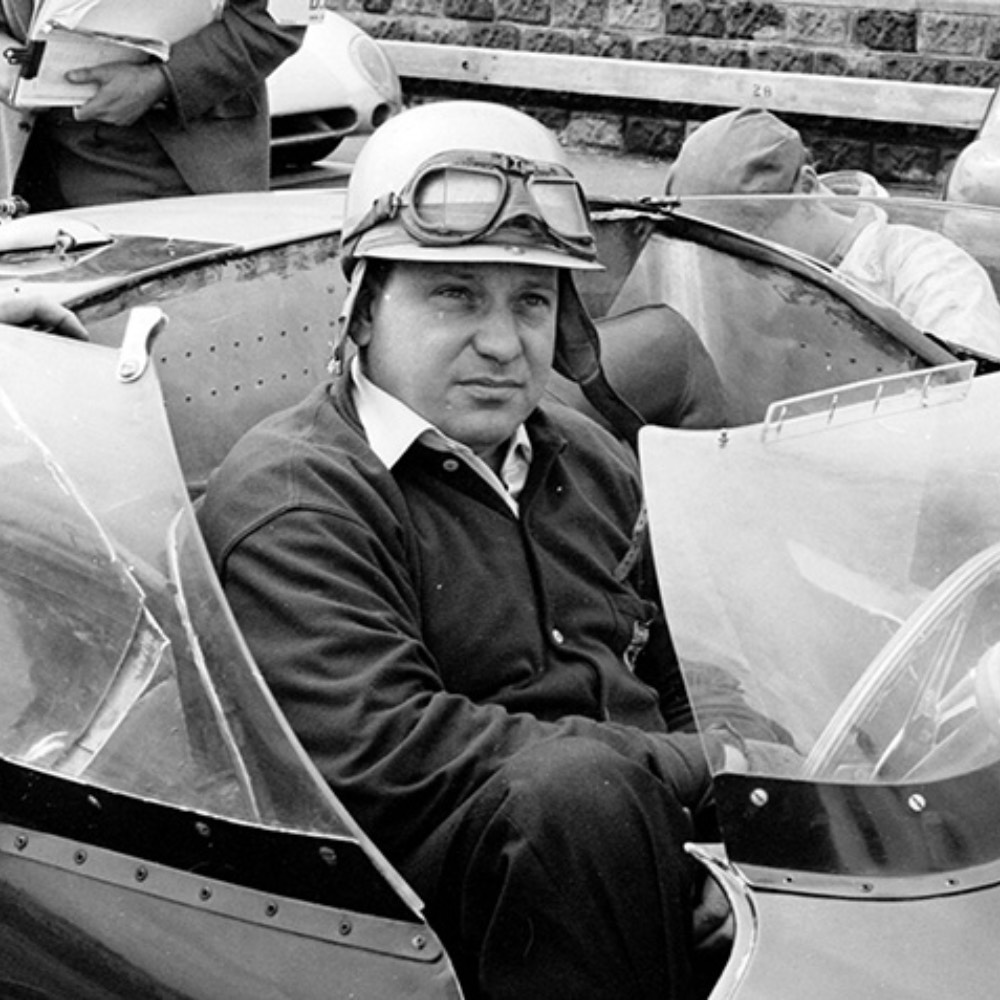
Ivor Bueb
Career Statistics
Biography
Ivor Léon John Bueb (6 June 1923 - 1 August 1959) was a British racing driver who competed in Formula One during 1957-1959, winning the 24 Hours of Le Mans twice (1955 and 1957) and establishing himself as one of Britain's finest sports car drivers before his tragic death in a racing accident at age 36. Born in East Ham, Essex, on 6 June 1923, Bueb came from an international family background—his father Léon Gervase Bueb was born in Breisach, Germany, to French parents, while his mother Grace Marie Alice Vagnolini had English, Italian, and Welsh grandparents. This multicultural heritage gave Bueb a European perspective that would serve him during his international racing career. Bueb's early adulthood was defined by World War II, during which he served in the Royal Air Force, experiencing combat and serving Britain throughout the conflict.
After returning from war, Bueb invested money into selling ex-War Department vehicles in Newport, Monmouthshire—a practical business venture taking advantage of surplus military equipment. This business provided income while Bueb pursued his growing interest in motorsport. Bueb started racing seriously in 1953 with a Formula 3 500cc Cooper, competing in Britain's thriving 500cc category that provided affordable single-seater racing for aspiring drivers. His talent quickly became apparent, and by 1955 he had graduated to the Cooper works team, finishing second in the British Formula 3 championship and establishing himself as one of Britain's most promising drivers.
While Formula 3 provided Bueb's single-seater foundation, sports car racing brought him his greatest achievements. In 1955, Bueb was selected to drive for Jaguar at the 24 Hours of Le Mans, partnering with Mike Hawthorn in a Jaguar D-type. The 1955 Le Mans race became the greatest tragedy in motorsport history when Pierre Levegh's Mercedes-Benz 300 SLR crashed into spectators at approximately 150 mph, killing Levegh and more than 80 spectators in motorsport's deadliest accident. As the tragedy unfolded, several manufacturers withdrew their entries, but Jaguar's crews continued racing.
Hawthorn and Bueb drove brilliantly throughout the night and following day, ultimately taking victory in the most tragic Le Mans in history. Bueb's victory was bittersweet—achieving motorsport's greatest endurance racing prize amid unprecedented catastrophe. In 1957, Bueb won Le Mans for a second time, this time driving for the Scottish privateer team Ecurie Ecosse, partnering with Ron Flockhart in a Jaguar D-type. This second Le Mans victory confirmed Bueb's status among endurance racing's elite and demonstrated that his 1955 win had been no fluke.
Two Le Mans victories established Bueb as one of Britain's finest endurance drivers, possessing the consistency, pace, and mechanical sympathy required for success in motorsport's most demanding 24-hour race. Bueb made occasional Formula One World Championship starts from 1957-1959, driving for various privateer teams. In 1957, he drove a Connaught and a Maserati run by Gilby Engineering. In 1958, he raced Bernie Ecclestone's Connaught at Monaco—Ecclestone would later become Formula One's commercial supremo—and drove a Formula 2 Lotus at the German Grand Prix.
His Formula One career never gained traction, with various non-qualifications and retirements preventing him from scoring World Championship points, though he demonstrated competence when the equipment allowed. Following the death of Archie Scott Brown at Spa in May 1958, legendary constructor Brian Lister hired Bueb to fill the vacant Lister-Jaguar driver's seat. Bueb performed admirably throughout 1958-1959, scoring several victories at prestigious British circuits including Crystal Palace and Goodwood, demonstrating the pace that had brought him Le Mans success. His performances for Lister established him as a leading sports car driver in the British scene.
Tragedy struck on 1 August 1959. After participating in two races at Aintree, Bueb traveled to France to compete in a Formula 2 race at the Circuit de Charade near Clermont-Ferrand. Driving the British Racing Partnership's Cooper T51-Borgward, Bueb crashed heavily and was thrown from the car, sustaining severe injuries. He was rushed to hospital in Clermont-Ferrand but never recovered, dying six days later on 1 August at age 36.
Bueb's death devastated British motorsport, claiming one of the nation's finest sports car drivers at the height of his abilities. His death, coming just 15 months after Archie Scott Brown's fatal accident, led Brian Lister to shut down his successful sports car racing operation, unable to continue after losing two drivers to racing accidents. Ivor Bueb was buried with military honors befitting his RAF service during World War II. Though his Formula One career never flourished, Bueb's legacy rests securely on his two Le Mans victories in 1955 and 1957—achievements that place him among Britain's most successful endurance racing drivers.
His death at 36 added another name to the long list of talented drivers killed during motorsport's deadly 1950s, a decade when fatal accidents claimed many of the era's finest competitors. Today, Ivor Bueb is remembered as a Le Mans winner, RAF veteran, and one of Britain's finest sports car drivers whose career was tragically cut short.