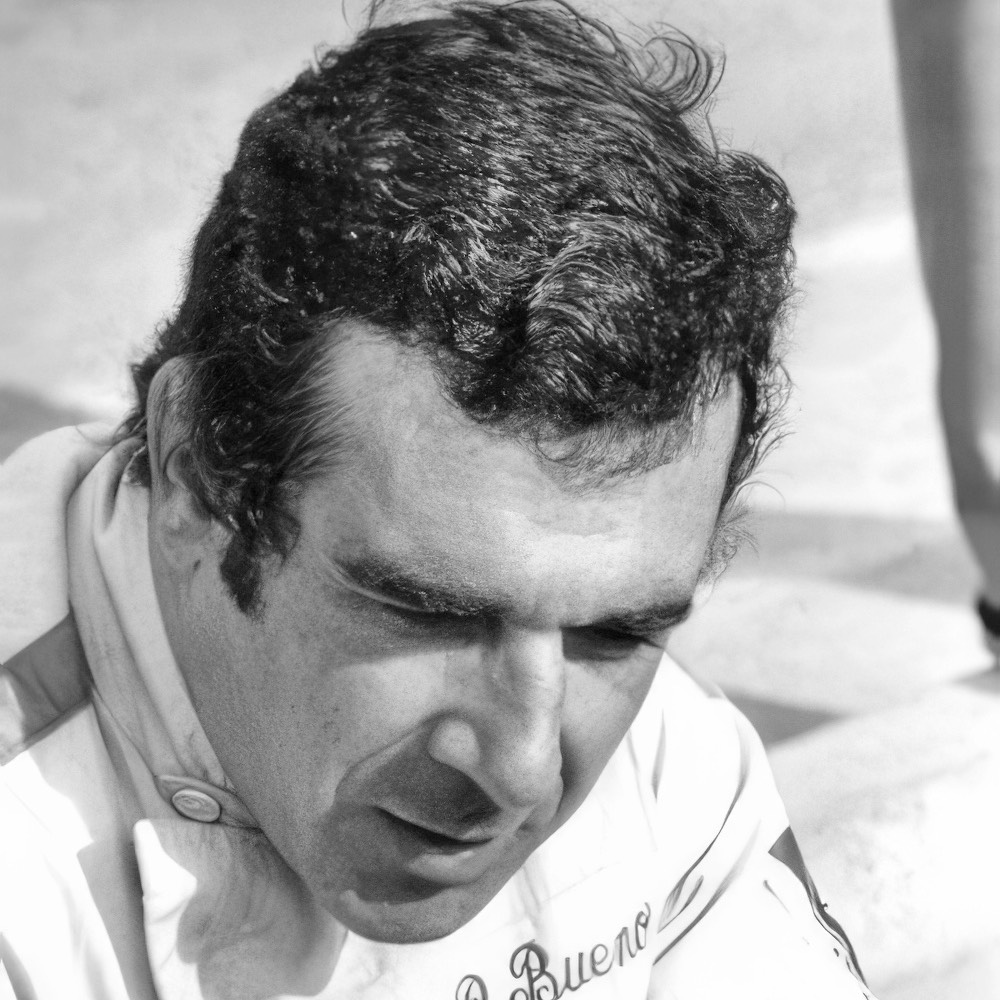
Luiz Bueno
Career Statistics
Biography
Luiz-Pereira Bueno (16 January 1937 - 8 February 2011) was a Brazilian racing driver who competed in one Formula One World Championship Grand Prix, the 1973 Brazilian Grand Prix, while achieving far greater success in Brazilian domestic racing where he won multiple national championships. Born in Brazil on 16 January 1937, Bueno competed throughout the 1960s and 1970s in various categories, establishing himself as one of Brazil's leading drivers in domestic competition. His racing career encompassed Formula Ford, sports car racing, touring cars, and occasional Formula One opportunities, demonstrating versatility across multiple disciplines. In 1969, Bueno competed in British Formula Ford 1600 for the SMART team, driving a Merlyn chassis with considerable success.
He took five victories at Snetterton and Croft circuits, plus three more wins at Brands Hatch, demonstrating genuine speed and racecraft against Britain's competitive Formula Ford fields. His British Formula Ford campaign established Bueno as a driver with international-level talent, though his opportunities to compete in Europe remained limited due to financial constraints common for South American drivers during this era. Bueno's Formula One opportunity came at the 1973 Brazilian Grand Prix at Interlagos on 11 February, when he secured a drive with the Surtees team for his home race. Driving the Surtees TS14-Ford, Bueno qualified for the race and competed alongside the world's best drivers, though he faced an enormous performance gap between his midfield equipment and the dominant Lotus, Tyrrell, and McLaren teams.
His race ended in retirement, leaving him without championship points, but merely qualifying and starting a World Championship Grand Prix at home represented a significant achievement for a primarily domestic Brazilian racer. Beyond his single World Championship start, Bueno participated in the non-championship 1972 Brazilian Grand Prix, where he achieved a respectable sixth-place finish. This non-championship result demonstrated that given competitive equipment and circumstances, Bueno possessed the pace to score points-equivalent finishes, though Formula One opportunities at that level never materialized for a full-time campaign. Bueno's greatest successes came in Brazilian domestic racing, where he won multiple championships competing against Brazil's finest drivers.
In 1972, he won the Brazilian Sportscar Championship driving a Porsche 908/3, one of the most competitive sports racing prototypes of the era. This championship victory established Bueno as Brazil's leading sports car driver and demonstrated his ability to manage powerful, demanding machinery during long-distance races. In 1975, Bueno captured the Division 4 Championship, a sports prototype championship in Brazil, adding another national title to his résumé. The following year, 1976, Bueno switched to touring car racing, driving a Ford Maverick in Brazil's touring car series.
Despite the significant change from sports prototypes to production-based saloon cars, Bueno adapted quickly and finished second in the championship, narrowly missing another title while demonstrating his versatility across vastly different racing machinery. These Brazilian national championships—1972 Sportscar, 1975 Division 4, and runner-up in 1976 Touring Cars—represent Bueno's true legacy, far exceeding his brief Formula One appearance in significance and achievement. Throughout the 1970s and into the 1980s, Bueno remained active in Brazilian motorsport, competing in various categories and maintaining his status among Brazil's respected racing drivers. His career coincided with Brazil's golden age of motorsport, when drivers like Emerson Fittipaldi and Nelson Piquet were achieving Formula One World Championships while domestic Brazilian racing flourished with strong fields and enthusiastic crowds.
After retiring from competitive driving, Bueno remained connected to Brazilian motorsport, though he maintained a relatively low public profile compared to his more famous contemporaries who had achieved international success. His contributions to Brazilian racing were primarily appreciated within Brazil rather than internationally, reflecting the reality that domestic champions often receive less recognition than drivers who compete in world championships. Luiz-Pereira Bueno passed away on 8 February 2011 at age 74 after battling cancer. Though his Formula One career consisted of a single race entry at the 1973 Brazilian Grand Prix, Bueno's legacy rests on his multiple Brazilian national championships, his British Formula Ford success, and his decades competing at Brazil's highest national level.
His story exemplifies the many talented drivers who achieved domestic success without securing the financial backing needed for sustained international campaigns, yet who contributed significantly to their national motorsport scenes and earned respect from those who competed against them.