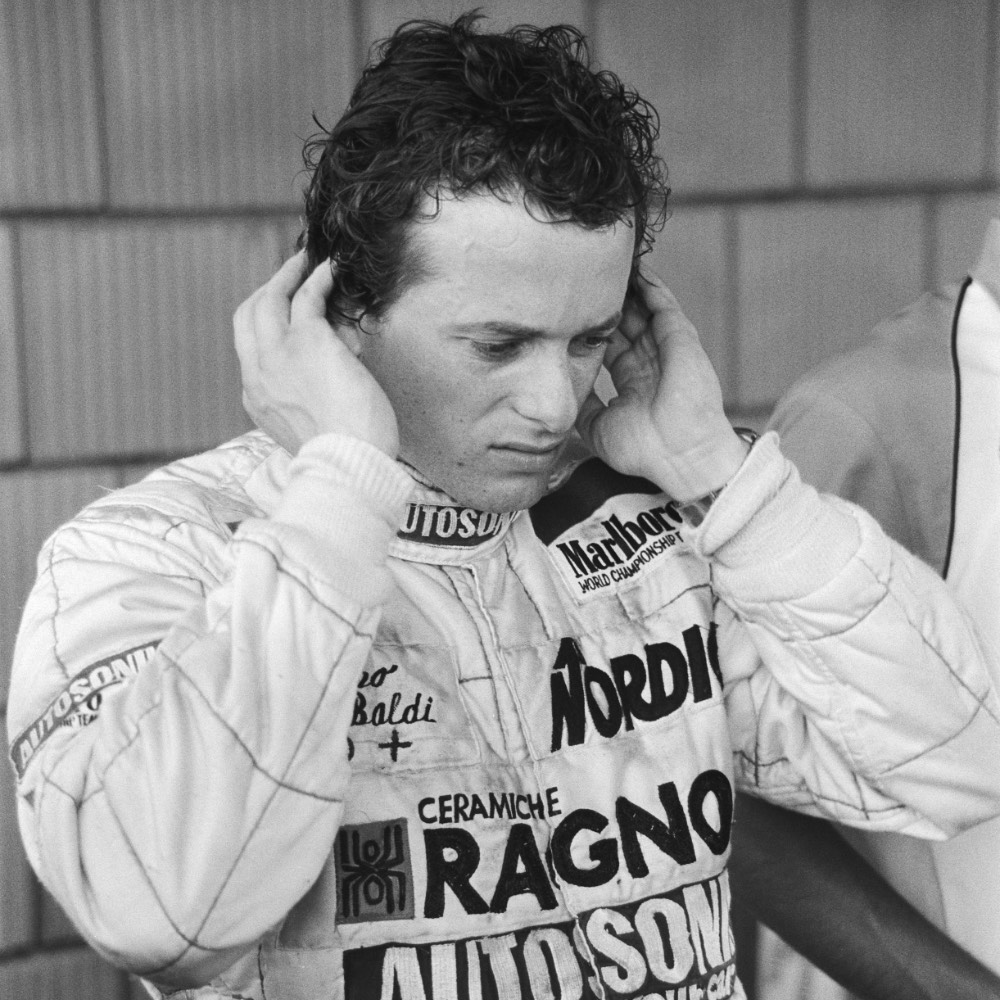
Mauro Baldi
Career Statistics
Biography
Mauro Giuseppe Baldi (born 31 January 1954) is an Italian former racing driver who competed in Formula One from 1982 to 1985, before achieving remarkable success in sports car and endurance racing, including victory at the 24 Hours of Le Mans and becoming one of only eleven drivers to complete the informal Triple Crown of endurance racing. Born in Reggio Emilia, Italy, Baldi began his motorsport career in rallying in 1972 before transitioning to circuit racing in 1975 with the Italian Renault 5 Cup. His talent quickly became apparent as he progressed through the junior formulae, and by 1980 he had established himself as one of Europe's top Formula 3 drivers. That year, he won the prestigious Monaco Formula 3 Grand Prix, a race that has historically served as a showcase for emerging talent and a gateway to Formula One.
In 1981, Baldi dominated the European Formula 3 Championship, securing the title with eight victories throughout the season. His comprehensive championship performance earned him recognition as one of the most promising young drivers in Europe and attracted the attention of Formula One teams. In an unusual move that demonstrated the confidence in his abilities, Baldi bypassed Formula 2 entirely to join the Arrows Formula One team for the 1982 season. His rookie season proved challenging but showed flashes of promise.
While he suffered three DNQs (Did Not Qualify) in the ultra-competitive field, Baldi also demonstrated his potential by reaching the points on two occasions, finishing sixth at both the Dutch Grand Prix at Zandvoort and the Austrian Grand Prix at the Österreichring. These results proved he belonged at Formula One's highest level despite the steep learning curve. For 1983, Baldi secured a move to the Alfa Romeo team, which offered potentially more competitive machinery. He scored his best-ever Formula One result that season with a fifth-place finish at Zandvoort, demonstrating consistency at the Dutch circuit.
However, the 1983 season proved difficult overall for Alfa Romeo, and Baldi struggled to consistently challenge for points. When Benetton became Alfa Romeo's title sponsor for 1984, the team underwent restructuring, and Baldi lost his seat in the resulting changes. He joined the underfunded Spirit team for 1984 and 1985, but the team's limited resources meant he had little opportunity to demonstrate his talents. After struggling with uncompetitive machinery at Spirit, Baldi's Formula One career ended in 1985, having competed in 36 Grands Prix and scored five championship points.
However, rather than marking the end of his motorsport career, leaving Formula One proved to be the beginning of Baldi's greatest achievements. He transitioned to sports car racing, where he would find the success that had eluded him in Grand Prix racing. In 1990, Baldi achieved a career-defining triumph by winning the FIA World Sports Prototype Championship for Drivers, sharing the championship-winning Sauber-Mercedes with French driver Jean-Louis Schlesser. This victory established him as one of the world's premier endurance racing drivers.
Baldi's greatest single achievement came at the 1994 24 Hours of Le Mans, where he shared the winning Dauer 962 Le Mans (a modified Porsche 962) with Yannick Dalmas and Hurley Haywood. The victory at La Sarthe, motorsport's most prestigious endurance race, represented the pinnacle of his career and cemented his status among endurance racing's elite. In 1998, Baldi achieved another historic milestone by winning both the 24 Hours of Daytona and the 12 Hours of Sebring, sharing drives with Arie Luyendyk and Didier Theys. The Sebring victory was particularly significant as it meant Baldi had completed the informal Triple Crown of endurance racing—victories at Le Mans, Daytona, and Sebring.
He joined an exclusive club of only eleven drivers to have achieved this remarkable feat, placing him alongside legends like A.J. Foyt, Phil Hill, and Jochen Rindt. Baldi added a second Daytona 24 Hours victory in 2002, further enhancing his endurance racing résumé. Throughout his sports car career, he became known for his smooth driving style, exceptional consistency, and ability to preserve machinery during long-distance races—qualities that are essential for endurance racing success but were less apparent during his Formula One tenure with predominantly uncompetitive equipment.
Today, Mauro Baldi is remembered not for his brief Formula One career, but for his outstanding achievements in endurance racing, where he proved himself to be one of the greatest long-distance drivers of his generation and earned a place in motorsport history.