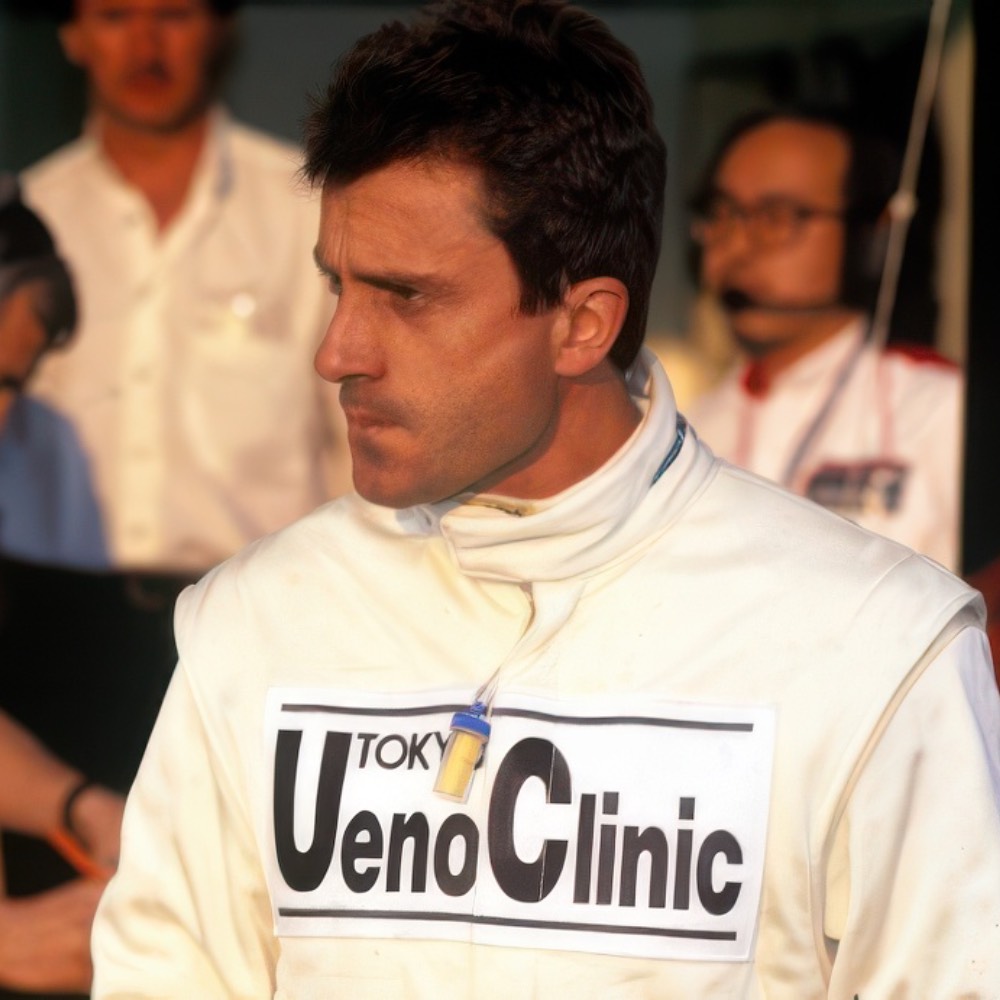
Yannick Dalmas
Career Statistics
Biography
Yannick Dalmas (born 28 July 1961) is a French former racing driver who competed in 49 Formula One World Championship Grands Prix between 1987 and 1994, qualifying for only 24 of those races and scoring no World Championship points despite showing promise early in his career, but who achieved far greater success in sports car racing, winning the 24 Hours of Le Mans an extraordinary four times—in 1992, 1994, 1995, and 1999—with four different manufacturers (Peugeot, Dauer-Porsche, McLaren, and BMW), a unique achievement in the history of the world's most famous endurance race, and establishing himself as one of the greatest endurance racing drivers of his generation even though Formula One success completely eluded him.
Born in Le Beausset, Var, France, on 28 July 1961, Dalmas originally competed in motocross during his teenage years, but a serious leg injury forced him to abandon motorcycle competition, and he switched to four-wheeled motorsport where his talents quickly became apparent through his progression in the French junior formulae. Dalmas was crowned 1984 French Formula Renault Champion and followed this with the 1986 French Formula 3 Championship, and his success in F3 earned him the nickname 'The New Alain Prost' in French motorsport media, as observers believed he possessed the smooth driving style and tactical intelligence that had made Prost a Formula One World Champion. Dalmas' Formula One debut came at the 1987 Australian Grand Prix on 18 October 1987 driving for the small Larrousse team, and in this maiden race he finished fifth, a stunning result for a Formula One debutant that suggested a brilliant career lay ahead, though this promise would never be fulfilled for reasons partly related to health issues and partly due to the uncompetitive machinery he drove throughout his Formula One career.
Crucially, Dalmas was not eligible to score World Championship points at the 1987 Australian Grand Prix because he had not competed in sufficient races during the season to be classified as a championship-eligible driver under the regulations of the time, meaning that his impressive fifth-place finish in his debut race earned him no statistical recognition in the championship standings, a bureaucratic technicality that meant he would never score a Formula One World Championship point despite racing in Formula One for seven years. Towards the end of the 1988 season, Dalmas was diagnosed with Legionnaires' disease (Legionellosis), a severe form of pneumonia caused by Legionella bacteria, and the illness forced him to miss the final two races of the season while he recovered, and although he was healthy enough to resume racing before the 1989 season began, the disease had clearly affected his physical condition and may have contributed to his subsequent struggles in Formula One.
Throughout his Formula One career from 1987 through 1994, Dalmas competed for teams including Larrousse, AGS, and Larrousse again, but these were consistently midfield or backmarker operations that lacked the resources to provide competitive equipment, and combined with Dalmas' ongoing struggles to consistently qualify for races—he entered 49 Grands Prix but qualified for only 24 of them—his Formula One career never approached the success that his junior formula achievements and his stunning debut had promised. While struggling in Formula One, Dalmas discovered his true calling in sports car endurance racing, and in 1992 he achieved his first victory at the 24 Hours of Le Mans, driving a Peugeot 905 and demonstrating the consistency, mechanical sympathy, and tactical intelligence required for success in the world's most demanding endurance race.
His 1994 Le Mans victory came in dramatic fashion, as Dalmas shared a Dauer-Porsche 962 LM with teammates Mauro Baldi and Hurley Haywood, and the Porsche snatched the lead just two hours from the finish when the leading Toyota suffered technical troubles, giving Dalmas his second Le Mans triumph with a different manufacturer than his first victory. The 1995 Le Mans race brought Dalmas arguably his most famous victory, as he drove the McLaren F1 GTR—the road-car-based GT machine that shocked the prototype world by winning overall at Le Mans—alongside Finnish driver JJ Lehto and Japanese driver Masanori Sekiya, and this unexpected victory by a GT car against purpose-built prototypes became one of the most celebrated moments in Le Mans history.
Dalmas' fourth and final Le Mans victory came in 1999 when he shared a BMW prototype with Pierluigi Martini and Joachim Winkelhock, and this victory with BMW gave him the distinction of winning Le Mans with four different manufacturers—Peugeot, Porsche, McLaren, and BMW—a feat unique in the history of the race and one that demonstrated his adaptability and his ability to master different types of racing cars and team environments. Since retiring from professional racing, Dalmas has worked for the FIA (Fédération Internationale de l'Automobile) as a driver advisor, a role that includes track safety testing where his decades of experience at circuits around the world make him invaluable for evaluating safety improvements and circuit modifications.
Dalmas also serves as the official World Endurance Championship Safety Car driver and Racing Safety Officer for the series, positions that combine his driving expertise with his deep understanding of circuit safety and race control procedures, and his presence at WEC races ensures that one of endurance racing's greatest champions continues contributing to the sport he dominated for so many years. Yannick Dalmas' legacy in motorsport is complex: his Formula One career was a disappointment, with 49 race entries, only 24 race starts, and zero championship points, statistics that suggest a driver who never belonged at Formula One's level, yet his four Le Mans victories with four different manufacturers, his success in other sports car championships, and his reputation among endurance racing insiders as one of the smoothest and most intelligent drivers of his generation demonstrate conclusively that he possessed world-class talent that simply was never suited to Formula One or never received the opportunity to shine in Grand Prix racing.
His story represents dozens of talented drivers whose Formula One careers failed to reflect their true abilities, and who found far greater success in other motorsport disciplines, proving that Formula One is not the only measure of a racing driver's greatness and that drivers like Dalmas who achieved legendary status in sports car racing deserve recognition as world-class talents regardless of their Formula One statistics.