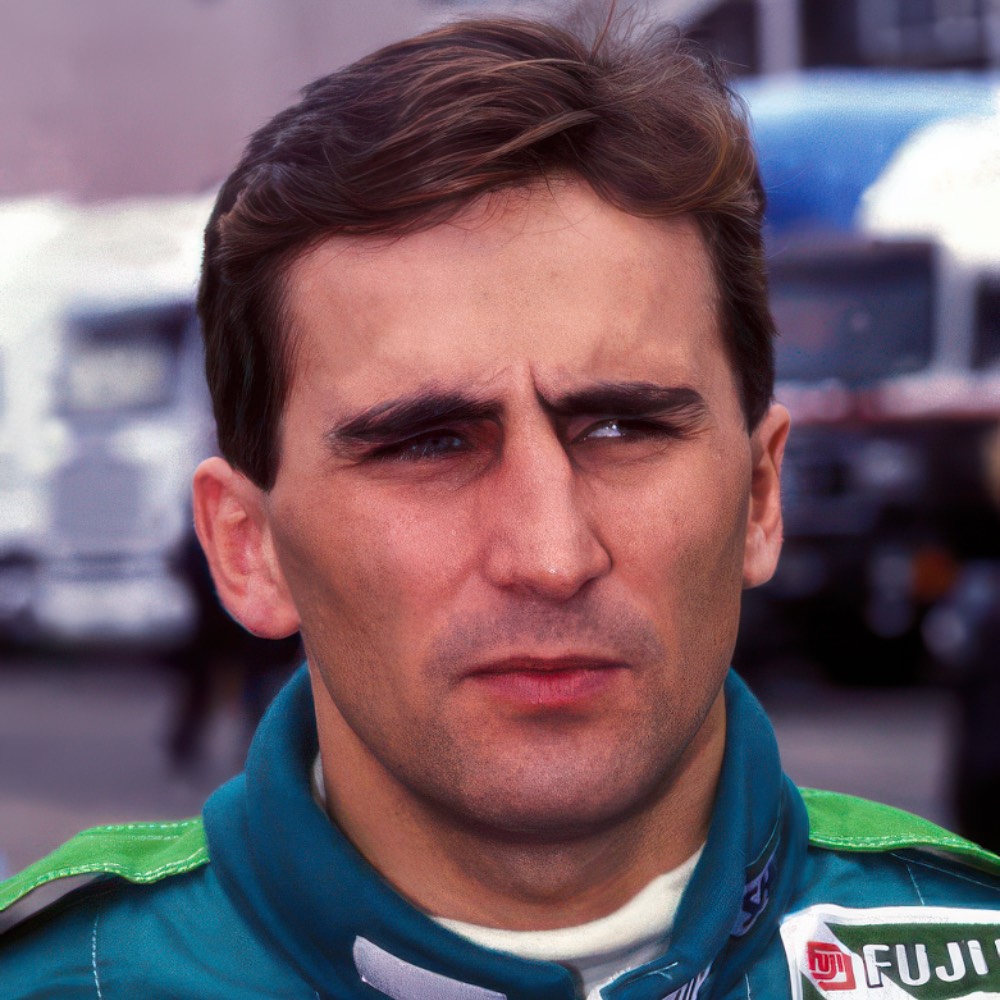
Alessandro Zanardi
Career Statistics
Biography
Alessandro 'Alex' Zanardi (23 October 1966 - Present): Italian racing driver and Paralympic champion from Bologna whose remarkable life story spans success in Formula One, dominance in CART, a devastating accident that resulted in both legs being amputated, and a triumphant return to achieve Paralympic gold medals. Zanardi competed in Formula One from 1991 to 1994 and again in 1999, participating in 41 Grands Prix for Jordan, Minardi, Lotus, and Williams, with his best result being sixth place at the 1993 Brazilian Grand Prix. His Formula One career, while showing promise, struggled with limited success across teams that lacked competitive machinery. Zanardi's greatest success came in American open-wheel racing where he became a two-time CART Champion in 1997 and 1998, winning 15 races with Chip Ganassi Racing.
His aggressive, spectacular driving style made him a fan favorite, and his final race of 1996 at Laguna Seca produced 'The Pass'—a legendary overtake on Bryan Herta at the Corkscrew that remains one of motorsport's most iconic moments. The move saw Zanardi pass on the outside, all four wheels off the track, to snatch victory on the final lap. Zanardi returned to CART in 2001 with Mo Nunn Racing, but on 15 September 2001, tragedy struck at the Lausitzring in Germany during the American Memorial 500. After a pit stop, Zanardi lost control of his car accelerating out of the pit lane and spun into the path of oncoming traffic.
Alex Tagliani and Patrick Carpentier, traveling at over 200 mph, were unable to avoid him. Carpentier's car struck Zanardi's, severing both of Zanardi's legs at the knees. Zanardi lost three-quarters of his blood volume and survived only due to the rapid intervention of the circuit's medical team, led by Dr. Steve Olvey, who performed emergency procedures at the crash site. After multiple surgeries and rehabilitation, Zanardi faced the end of his professional racing career, but what followed demonstrated extraordinary resilience.
Remarkably, wearing prostheses he designed himself, Zanardi returned to competitive racing in 2003, less than two years after his accident. He raced for BMW in the World Touring Car Championship for six seasons from 2004 to 2009, winning four races and competing at the highest level against able-bodied drivers. His return inspired millions worldwide and proved that physical limitations need not define capability. Zanardi then turned his attention to Paralympic hand-cycling, achieving remarkable success.
At the 2012 London Paralympics, he won gold medals in both the individual H4 time trial and the individual H4 road race, plus a silver medal in the mixed H1-4 team relay. At the 2016 Rio de Janeiro Paralympics, he won gold medals in the H5 category time trial and mixed team relay, and silver in the road race. These achievements established Zanardi as one of the greatest Paralympic athletes. On 19 June 2020, Zanardi was involved in another serious accident while competing in the Obiettivo tricolore hand-cycling race near Siena, Italy.
His hand-bike collided with a truck, and he suffered severe head and facial trauma. After undergoing three hours of neurosurgery and maxillofacial surgery, Zanardi was placed in a medically induced coma. He spent months in hospital undergoing multiple surgeries and rehabilitation. While his recovery continues to be challenging and private, his family has provided occasional updates indicating gradual progress.
Throughout his life, Zanardi has demonstrated remarkable courage, determination, and positive attitude. His autobiography 'My Story' and numerous interviews reveal a man who refused to be defined by tragedy, instead finding new ways to challenge himself and inspire others. His famous quote, 'The accident made me realize I could overcome any kind of difficulty,' encapsulates his philosophy. Zanardi has been honored with numerous awards including Italy's highest sporting honor, and his story has been featured in documentaries and books worldwide.
Known for his infectious enthusiasm, attacking driving style, engineering mindset (he designed many of his own prosthetic devices), and unwavering determination, Zanardi represents the very best of human spirit—transforming catastrophic setback into triumph and using his platform to inspire millions facing their own challenges. His legacy extends far beyond racing statistics, embodying resilience, courage, and the power of the human will.